Ideas, Practical and Otherwise
(Note that, due to the images, diagrams, tables on this page, it is best viewed on a desktop screen, or possibly tablet. You may have a little trouble on phones And other smaller screens, or have to scroll horizontally a bit.)
As I started assembling this page, I found a few older documents and sets of notes, and were this to be anything like a complete list the page would be very very long. I've decided to include just a few items, with no really well-defined criteria, other than that some are just amusing, others show perhaps different areas of interest. Many go back decades, others are newer.
Some ideas (well, many, really) aren't here, but other ones I have in the Current Projects category you may reach from the main web page.
There are several sections some of these ideas fall into, others just don't. The categories will come first.
MP3 Information Injection
I began thinking about this when I wanted to attach dates to everything in my music library - the nominal goal was to be able to easily/automatically construct playlists that might match what I might have heard, for instance, on an AM radio station in, say, 1977. That would include that year's hits, a lesser amount of the previous hits, a few scattered 'golden oldies', etc. This process in itself became fascinating, as many songs are 'covers' of earlier songs, some with ancestry stretching back into the 1920's and earlier. There are also complexities about versions of songs: studio recordings, live performances, long pieces edited down for AM radio stations, versions in 'greatest hits' albums, and so forth.
I began to consider the idea that a 'complete' MP3 file would include a lot of information: the producer, the writers/lyricists, the studio it was recorded in, all of the musicians' names, the lyrics, and so forth. One reason for this is that I could listen to all the pieces that a particular drummer played on, or (say) all songs produced by Alan Parsons, or find a song given some lyric fragments. One might track careers this way, even find noticeable pairings of musicians.
It would take a lot of work to assemble all of the information about a particular piece, but fortunately there are fan groups and the like that have much of the information at hand. By 'crowdsourcing' the assembly of this data, the quality would be high, the cost would be low, and the entire listening community would benefit.
MP3's really can't legally be shared, but there's no reason the information contained in them can't be. There are many tags; you may find the complete list here: https://id3.org/.
So the basic idea is for contributors to, for a given MP3, create and/or edit a ".ii" file (for "information injection"). It would have a tag name on one line, on the next the data, for as many tags as we have information. A software tool would take the .ii file and insert the information into the MP3 file. Over time, a library of publicly-available .ii files would let anyone augment their files as they wish.
I thought the simplest approach would be to use something like the old Windows initialization (".ini") format, e.g.:
[owner]

name = John Doe

organization = Acme Widgets Inc.


[database]

; use IP address in case network name resolution is not working

server = 192.0.2.62

port = 143

file = "payroll.dat"
Now there may be difficult cases, with conflicting information presented, but if done carefully this could be represented within the tag data (e.g., for a producer name, "John Doe" OR "Jane Doe". Or the conflict might remain unresolved, noted, with a feedback list to whomever is interested in that piece saying more research is needed.
I did begin writing code to do this, parsing the .ii file and using a 3rd-party tool to insert the tag information, but, like many things, it got paused.
Personal DJ
It can sometimes be hard to listen to one's own music. This problem was noticeable years ago with radio stations that specialized in certain genres; after a while of listening, I at least began to crave some relief by jumping to something else. I've heard that the satellite radio company Sirius XM had the same problem - many many channels, but each so specialized as to be tedious. (Nowadays they seem to have 'curated' channels, with selections and introductions by famous musicians).
But of course in the past radio DJ's did this, by, say, playing current hits, but mixing in old favorites or related songs, or even other versions of songs. The best I can do right now is "random shuffle".
So I thought of writing an "AI DJ". I would want to have it solve the above problem, but do more:
Environmental - take into account the season, the time of day, the local weather.
Personal dates - birthdays, anniversaries, other notable dates of me and my friends.
Historical events - "this day in history" sort of thing.
Social media - My Facebook (or whatever) page might indicate what I've been thinking about recently.
Mental focus - my recent internet searches would provide clues as to what I'm currently thinking about. This might extend to documents on my computer I've been reading or writing, including emails.
Biometric - my keystroke pattern, pulse (detected via retina and computer camera), work speed (document switches, typing speed); all those might at a minimum indicate whether I'm sleepy, or energized and working intensely, or trying to relax by browsing various sites.
Feedback - perhaps the most important thing of all. If the AI has some models of the above areas, which by song lyrics, pacing, etc. suggests something like a relaxing instrumental Spanish guitar piece, and I click "skip", the models should be adjusted accordingly (at least for the short-term; every day is different, but if I repeatedly reject certain classes of music at certain times the system should adjust.) This isn't easy to model, and it would likely end up tailored to the individual.
I began to write such a beast, not trying to solve the entire problem at once, but really just to grapple with it in order to understand its complexity. I had to pause due to work demands; and the one thing that I came up against that would take quite a bit of time was grabbing the lyrics to all of my music (and trying to have a program understand the meaning, mood, etc.), plus other information such as key, rhythm, and other critical metrics concerning (initially) more popular music. Jazz and Classical add their own complexities as well. Nevertheless I expect this sort of thing will appear at some point.
Human DJ's used to, and likely still do, this job quite successfully, and for wide audiences, so perhaps some learning algorithms applied there might jump-start this process.
Other
These more than likely have now been done by others; they likely aren't very hard, and if they're not out there and I get some time I might do some prototyping:
Human voice keyboard - The idea is to take something akin to a piano keyboard, but instead of a hammer hitting a string, a recording (or pseudo-random synthesis, to avoid repetition) of a human voice singing that particular note would be emitted. I don't think entire instrumental pieces would be composed like this, but being able to easily add choir-like elements to a composition might be useful. Something like a piano's pedals might add some multiplicity to the voice, so the sound would be as if several people were singing the same note.
Old Pianos - some old pianos are like works of art, but can no longer be effectively tuned. Often the cost of refurbishment is huge; for instance, we have a 1921 Steinway medium grand piano, it is generally ok, but the last time I checked it would be about $45K for Steinway to redo it and bring it back to its full glory (other people are cheaper, but if I'm at that kind of price point I'd want to do it right). Apparently it's worth it, as the rebuilt pianos are often more highly-valued than new ones. I'm not sure of the reasons for that - there are obvious things, like the real ivory keys, but apparently there are valid acoustic reasons as well.
We had another old upright piano, beautiful piece of furniture, that was effectively 'worn out'. My thought was to replace the strings that the hammers hit with piezo-electric film (which generates voltages proportional to the impact), and feed that in to a microprocessor. Now, for each key, I could record (say) a Steinway concert-level grand piano, and given the amplitude of the hammer strike, have the microprocessor just play the appropriately-attenuated recorded level, and play it out of speakers installed inside the piano. Now, I'd have a close-to-zero maintenance piano that should sound close to identical to the Steinway (there are issues of resonance, non-linear crosstalk between strings, and the like, but many of those would have been captured in the recording process). This might be a fairly inexpensive way to refurbish old pianos - in a way, by turning them into high-quality specialized electric keyboards.
Industrial keyboard - there are a huge variety of "industrial" sounds, from steam hammers to lathe noises to stamping machines, saws, and other more harmonic and pleasing sounds that arise due to material vibrations. I think it would be fun to compose pieces with these (or even render current music into this format) - to do it would require a fiarly vast library of such sounds, and a way to quickly search for them. The search part shouldn't be that hard - each, for instance, might be tagged with a type (e.g., percussion), and central frequency. The sounds themselves might be stretched and filtered to provide precisely what is needed.
As a not-quite relevant example, the Star Wars "laser blaster" sound was created from a recording of someone striking a taut cable. Sound designer Ben Burtt was hiking near a radio tower, and accidentally tapped a guy-wire, which produced a noticeable metallic twang. He recorded it, changed it a bit, and that's then what was used.
The first topic is a bit technical, if it's not you're cup of tea, more visual examples are further on.
Measuring Insulation Values
This is simple in concept, a bit harder to get the details correct. The insulation of a material is described by it's "R-value" - it's absolute thermal resistance - related to the thermal conductivity of the material. Now (ignoring radiant effects, such as sunlight), heat is transferred through a material (e.g., from one room to another) by molecules bumping into each other. On the warmer side they're moving faster, and as heat energy moves through the material they end up conveying some of that kinetic energy through the material to the cooler side. Molecules there end up moving a little faster, so that room warms up. Knowing the R value of a particular material, or the "effective R-value" of a compound structure such as a wall with studs, etc., is an important part of planning heating and cooling.
The R-Value is independent of the temperature differences between the two sides, and is often considered (for the material being analyzed) as independent of that material's temperature. That can't be completely true, as some materials change density as temperature changes, but for our purposes (generally the realms in which humans live) it may be taken as a working assumption.
It occurred to me that the underlying basic physical mechanism, that of mechanical collisions, is the same one that causes sound to propagate. So it should be the case that sound could be used to estimate the R-values of specific materials, or effective R-values of walls and such. In the literature there appears to be a correlation, very high for some materials (such as concrete), but low for others (e.g., glass - though it may be that radiative effects play a role there.
An very loose analogy between sound and heat might be ambient light and a laser. The ambient light might be diffuse and include a variety of frequencies - in my room right now there is sunlight, and while filtered through window glass it's still a mix of a wide range of frequencies. A laser is one frequency. Both are still light, and the same physics applies to each, though with a different emphasis on applications in each case.
Perhaps more important than just the R-value of a material is the effective R value of all of the components of a structure. If sound and thermal vibrations use the same mechanisms, they will travel through the same paths:
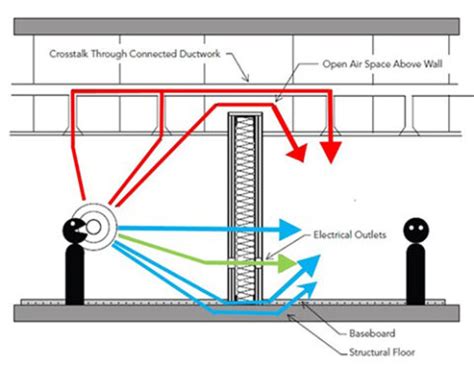
It's important to note that there is a very specific way in which this measurement should be carried out.
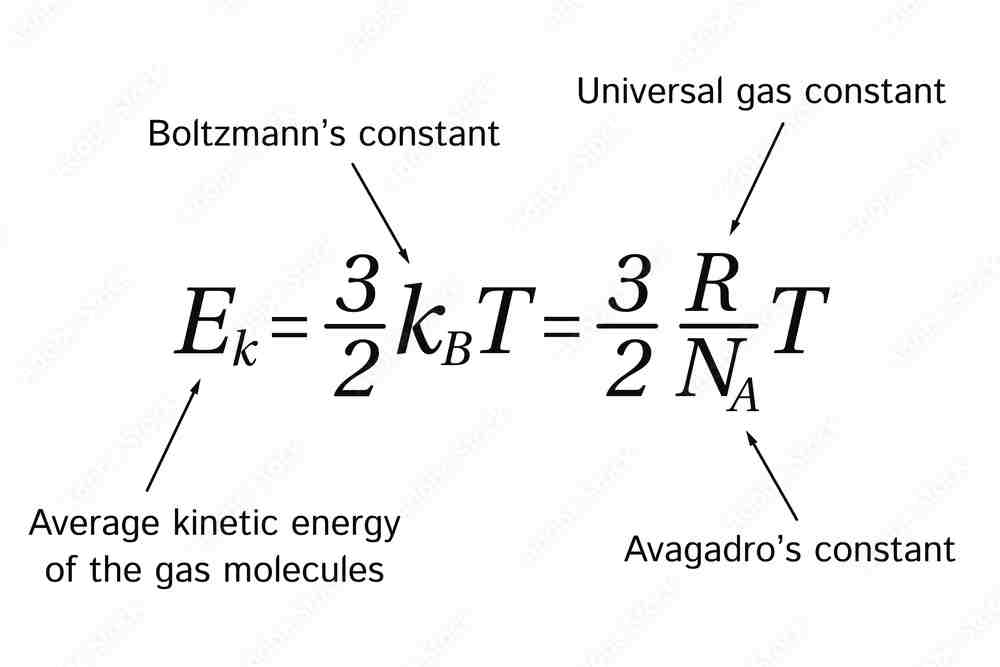
In a room with air at a specific temperature, the molecules have a variety of speeds, as given by the Maxwell-Boltzmann distribution:
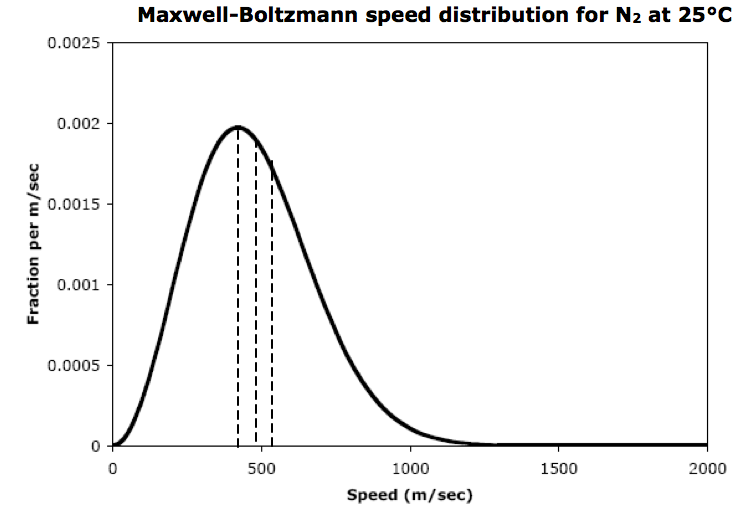
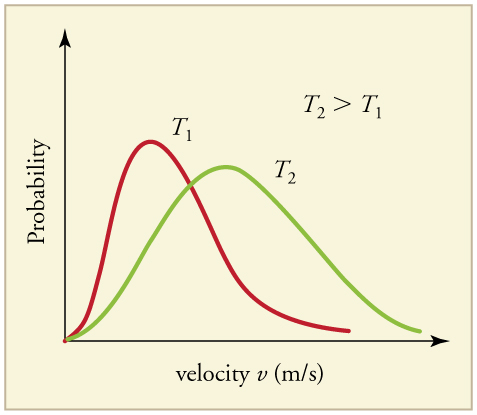
Beyond that, the molecules in the air are hitting the wall at different angles, which may be computationally a constant effect - though in ideal-gas computations often the 'normal' component is the only thing that matters, where for surfaces that aren't absolutely smooth, angular impacts may also transfer kinetic energy. The speed of sound varies with temperature as well, which effects the collision rate and mean-free-path of individual molecules. The Maxwell-Boltsmann distribution is also different with temperature:
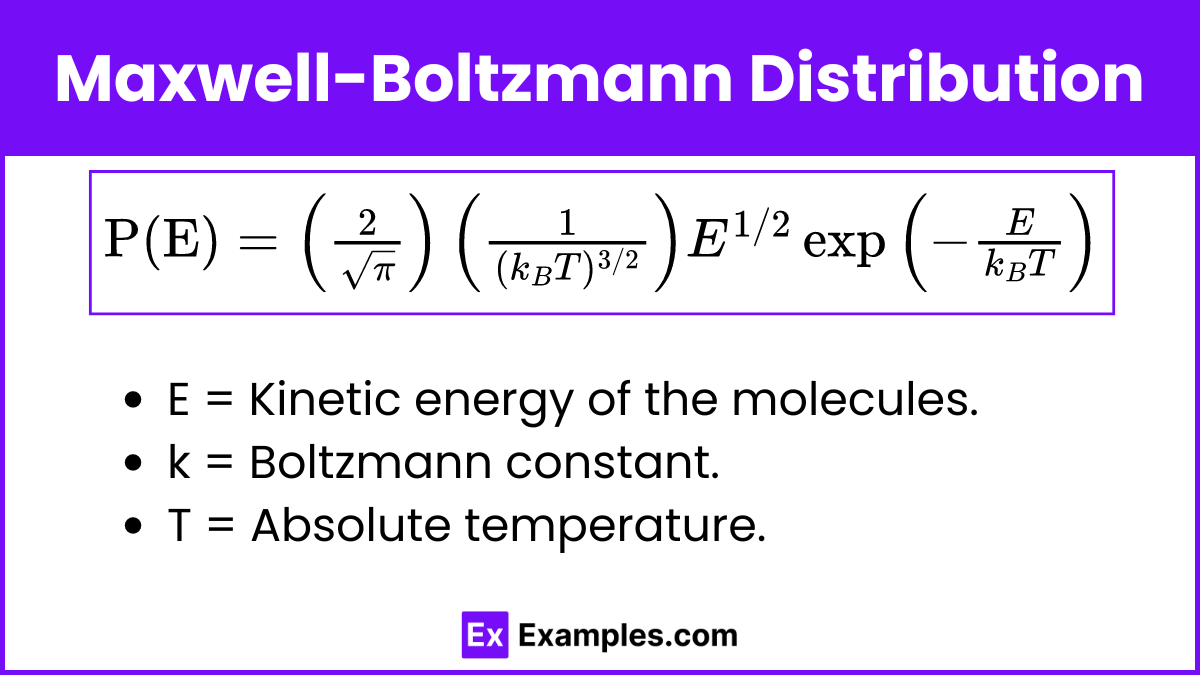
For those who want the specifics at a given temperature T:
| 
| |
| Probability of a particle having a given energy |
Average energy in a gas at a given temperature |
What you should take from the above is that, while the sound and thermal transfer mechanisms have the same underlying physics, there are some critical details that need to be taken into account.
So, given all of that, how does one use sound? Well, sound, in specifically a sinusoidal wave at a given amplitude and frequency, carries a certain amount of energy. I'll stop with the detailed formulas now - the energy in a sinusoidal wave is proportional to the amplitude squared and the frequency squared. The problem becomes: how does one generate a sound (a combination of different waves, with different amplitudes and frequencies) that has an energy distribution similar to the Boltzmann distribution at a specific temperature? If I have that in hand, I can for example play it in one room and listen in the adjacent room, and work out the effective R-factor.
I'm not going to go much further into this problem here. It should be reasonably clear that it's doable. Crudely speaking, for constant amplitude, one might determine (that is, notionally just 'write down') the set of frequencies that would have energies corresponding to the Boltzmann distribution, and then just do an inverse Fourier transform to determine a time-series that would have the correct energy distribution. (I believe that this may be done symbolically).
There are subtleties here too - the central idea is to use coherent sound to model an incoherent (somewhat random, with a specific energy distribution) state of air molecules. As noted above, one may generate a sound that conveys a certain energy by varying the frequency or the amplitude. So the "sound to use" to inject a specific amount of energy is not unique, and indeed a variety of exemplar sounds should be used. I'm going to skip the math here, but provide one intuitive reason: it's possible that one particular frequency is of the right wavelength to set up a standing wave inside the material, which would skew the results. A full treatment would be to construct an ensemble of time series, each representing a particle hitting the wall with a given energy - and then do inverse fourier transforms on all of those, and combine the results. That's sound - but the combinatorics of the millions of collisions are huge. There are mathematical methods to deal with this type of problem, but that discussion is far too lengthy for this entry - if you google search "fourier transforms and probability distributions" you'll find much of it.
There are some assumptions and further complexities, notably that the elements are all responding close to linearly. The resulting sound has to be loud enough to provide clean data. As the Boltzmann distribution varies with temperature, one doesn't just want to do this for one temperature, but for the entire range one is interested in (though that may still be represented as a single sound, unless one wants separate data by temperature). As noted above, the surface roughness of the wall may matter, which must be addressed by having a range of sound directions impinging on the wall.
One main advantage of this approach (and it has yet to be empirically proven), is that it takes into account the totality of compound structures - for instance walls, which may be brick, have studs and air spaces, then sheet rock. There are different energy paths through that structure, and even if one had measured the R-values for all the materials involved, how they act when assembled in some specific way would be very hard to compute. This might provide a way to just measure what one wants, the sum of all the thermal pathways from one space to another:
The Garden Gnome
This is a thought for a somewhat unusual addition to our outdoor deck. It's barely an architectural idea, but as it relates to our house, and it's kind of funny, I thought I'd start with it.
 The design would be to replace the eyes with animatronic eyes that are capable of tracking a human (so I'd likely start with a plastic, not
a concrete gnome), with CCD cameras in each. The data from the cameras would be transmitted to one of my PC's, and
the instructions for eye movements would be transmitted back.
The design would be to replace the eyes with animatronic eyes that are capable of tracking a human (so I'd likely start with a plastic, not
a concrete gnome), with CCD cameras in each. The data from the cameras would be transmitted to one of my PC's, and
the instructions for eye movements would be transmitted back.
I have (or had; this hasn't been active recently) the image processing code to do the motion detection, stereo processing to detect the moving object's location, and of course to track the moving object. The idea was to have the gnome on our large back deck, kind of facing the house, so that the background was relativly stationary.
If a person were to walk out on the deck, his or her presence would be noticed due to the motion; some shape info may then be useful in further tracking. The upshot would be that the gnome's eyes would "follow" the person, rather than staring straight ahead. This should be fun for unsuspecting guests.
Going a little further, if the face ID image processing detected a full-on face, that is someone staring at the gnome, it's eyes might snap back to straight ahead (if this were noticeable it could also be humorous). Going even further, one might add a microphone, speaker, and with some speech processing more amusement might ensue. The gnome might toss out random somewhat whispered comments such as "She's been putting on some weight", or even engage in simple gnome-like conversation.
A Concept for an Entire City Block
I think I started to think about something like this as a kid, riding the New Haven into New York City, and seeing what seemed to be city blocks of ruined buildings. I saw similar such things in Detroit, and elsewhere. The areas didn't seem to be the most inviting to live, but I expected that the real estate pricing would be low. The basic idea is one raised area covering the entire block.
I began about 8 years ago building a model of the concept, figuring that seeing it would convey the idea at a glance. I only got a little bit of that done, before life intervened (though I'll show some photos further on - the top part of my model has disappeared).
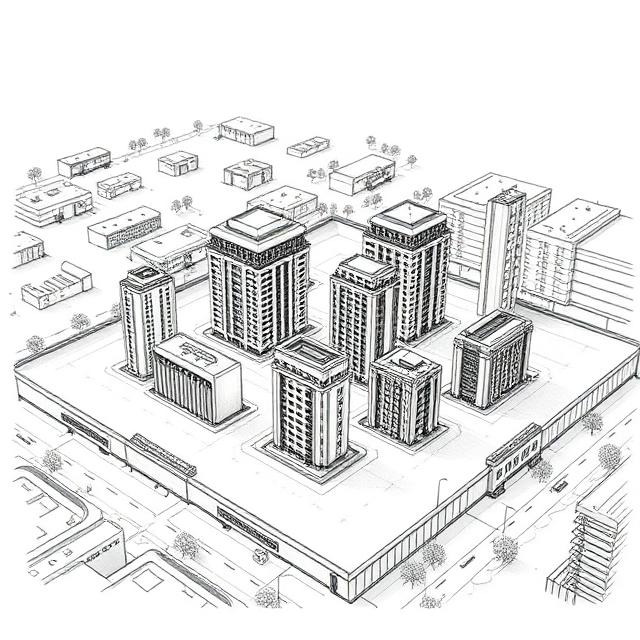
The central idea was that the block would be 'kind of' one building - the base being a four or so story structure, containing the mechanical systems (heating, etc.) and parking. At the top of that would be a grassy area, with buildings rising up, separated with pathways and small hillocks (perhaps containing walk-in entrances for various service controls, e.g. for a community pool). A rough AI-based sketch is below - it's too dense, but it provides a crude representation of the concept:
This is the part of my model that has survived, with some damage:
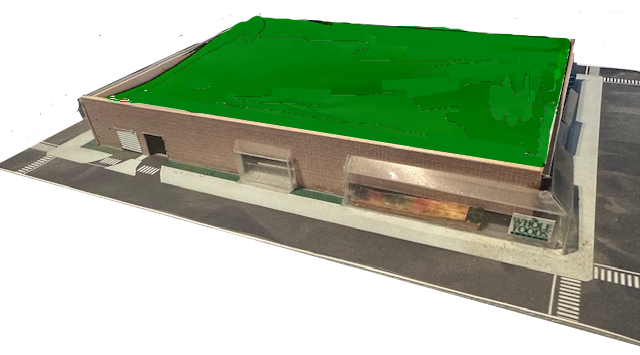
The upper surface and structures have gone. This shows the basic brick full-block base, with street level stores, pedestrian entrances (in the model there are images of elevators inside), and drive-in areas. The stores could be accessed by the general public (as, for instance, the Whole Foods one on the corner would be), but would also have secured access for those living in the towers above.
One obvious advantage of the design is security in what might otherwise be a questionable neighborhood (at least at the time of construction). Another would be the shared utilities implemented under the structures, in the basic raised 'block'.
My vision for this would include extensive greenery on the flat base 'roof', so it would feel park-like to walk through - possibly including a stream and small pond, as well as trees and small hills. The buildings in the above overview are wrong in a number of respects: they would likely create "wind tunnel" like areas between the buildings, and are a bit harsh in architectural feel. I might have fewer of them (the economics might dominate here, the number of units required for this to be profitable), I'd have a variety of heights, from 3 stories to perhaps 10, and I might rotate a few and space them to avoid the wind tunnel effect. Moreover, I would want them to be green too, as this building is:
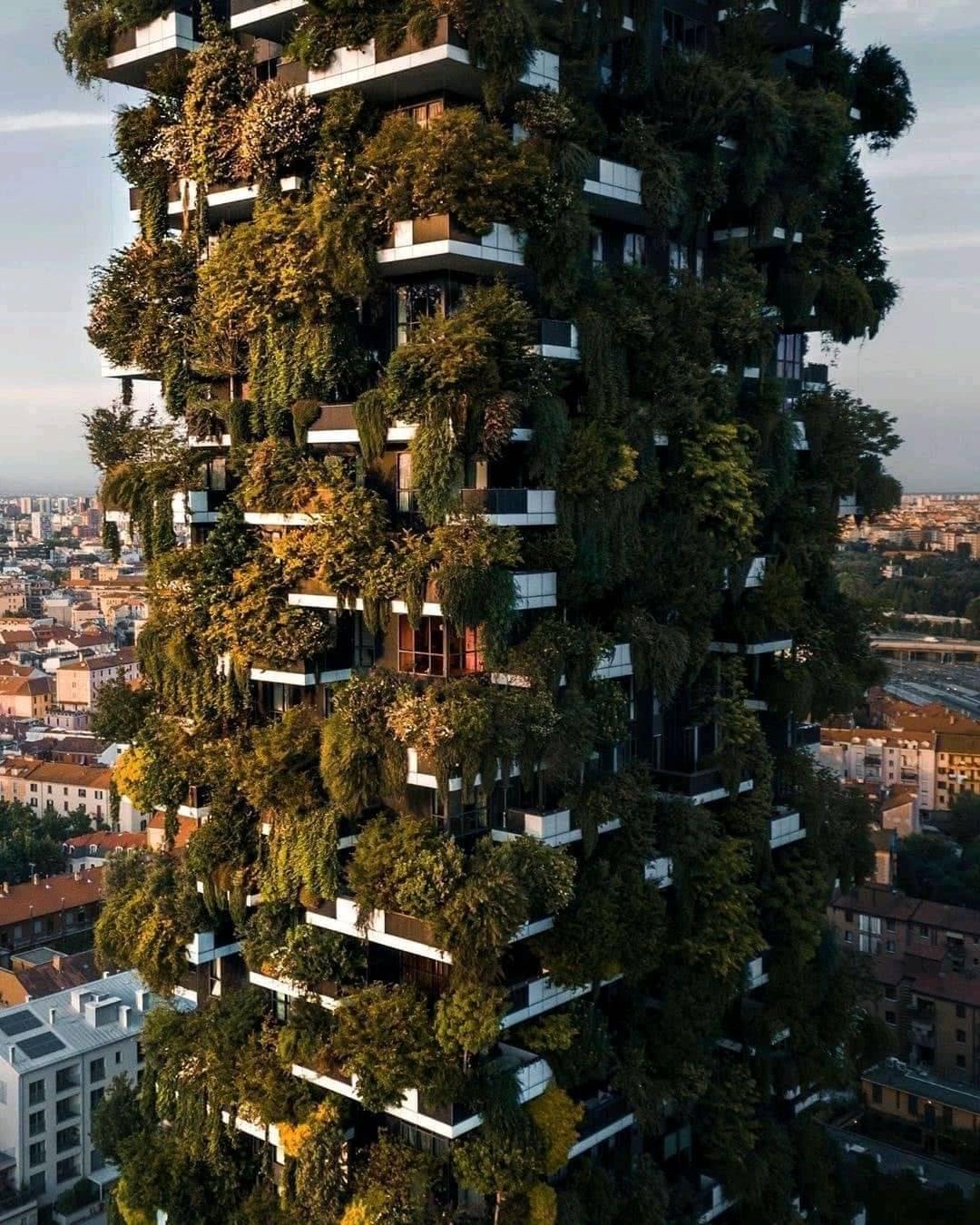
That might be a little over-the-top, but I think rather than dividing a floor up into units, I'd use two floors, so each unit had upper and lower components (with some exceptions for handicapped access). The building in the image above looks like it might have this property, as the balconies seem staggered as one moves around the structure.
It was constructing these as part of the model that dramatically slowed me down - I likely could have just printed the sides without 3D detail, but I kind of wanted to have the windows, balconies, hanging plants, etc. correct, and (before 3D printing and such) this was never completed.
I thought that now I wouldn't hold up presenting the entire idea due to that, though of course this summary is incomplete and must leave much to the imagination. Also, note that it would be hard to be 'complete' without the real dimensions of a target ruined city block - some are narrow in one dimension, and quite long in the other, while others may be more square-like. The specifics: number and layout of towers, paths, small surface hills, surface trees, all depend upon not only the details of the shape, but the compass orientation (for sunlight considerations) and the local climate.
I hope I've conveyed the 'feel' of the idea - the specifics would be location-based, not only due to the above concerns but also factors such as nearby road patterns and traffic, ground type, etc. as well as whatever modifications might be needed due to local regulations. But no matter the specific form a project like this would take, the intent would be for residents, or even offices in the towers, to have the feel of walking into a secure and green "island", with trees, and parklike raised area in which to stroll, community amenities like a swimming pool and/or health club - but without the general rectangular concrete aesthetic such structures usually have.
An Urban Penthouse
When I was living in Boston after MIT, I was mainly in apartments, and I wanted to buy a place. The prices seemed to be climbing significantly every year, so that a condo one year at $55,000 might be $90,000 the next year, and then into the low hundreds the year after. I couldn't afford to live any place that I'd want to live.
I started to think of creative options. One was something I'd thought about when I first went to MIT: to buy and rehab an old railroad caboose, and park it on a siding off of Vassar St (I didn't have time for the necessary arrangements for that). I wondered if I might do the same thing with an old Pullman railroad car. (Someone actually did that later, near MIT Steam Plant - I have no idea if it's still there, likely not.)
I used to drive (and walk) around the city for the fun of it. One day I was in the Fort Point Channel area, and an idea hit me. There were a number of old warehouse buildings there, mostly unused and/or abandoned, and I thought I might be able to build a small penthouse on top of one of them. (Old warehouses work well, as they're built to carry a lot of load, there's a lot of interior open space to allow the running of utilities, and, unlike modern office buildings, there aren't AC units and the like installed on the rooftop.)
I looked around and found one particular rooftop (outlined in red below) that I liked:
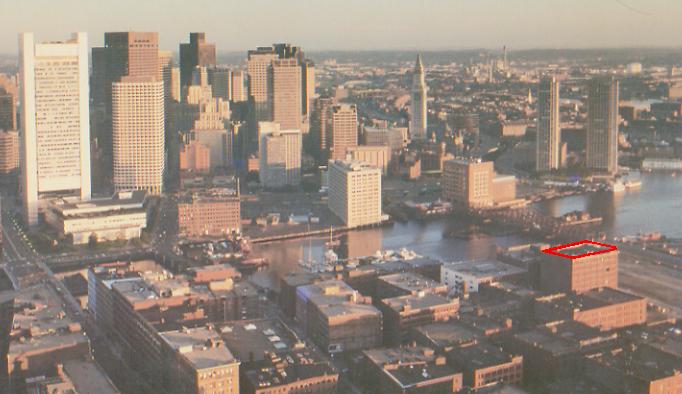
This was a good spot for several reasons: the tall buildings across Fort Point Channel were dramatic, and ended at the channel, and to the right and lower-right corner was Boston Harbor, so one would have a great view out towards the harbor islands. As I recall the address was 44 Farnsworth St., although I also noted buildings at 321 Summer St. and 495 Summer St. (As of this edit of this document, this entire area has been redeveloped extensively, so this is no longer practical).
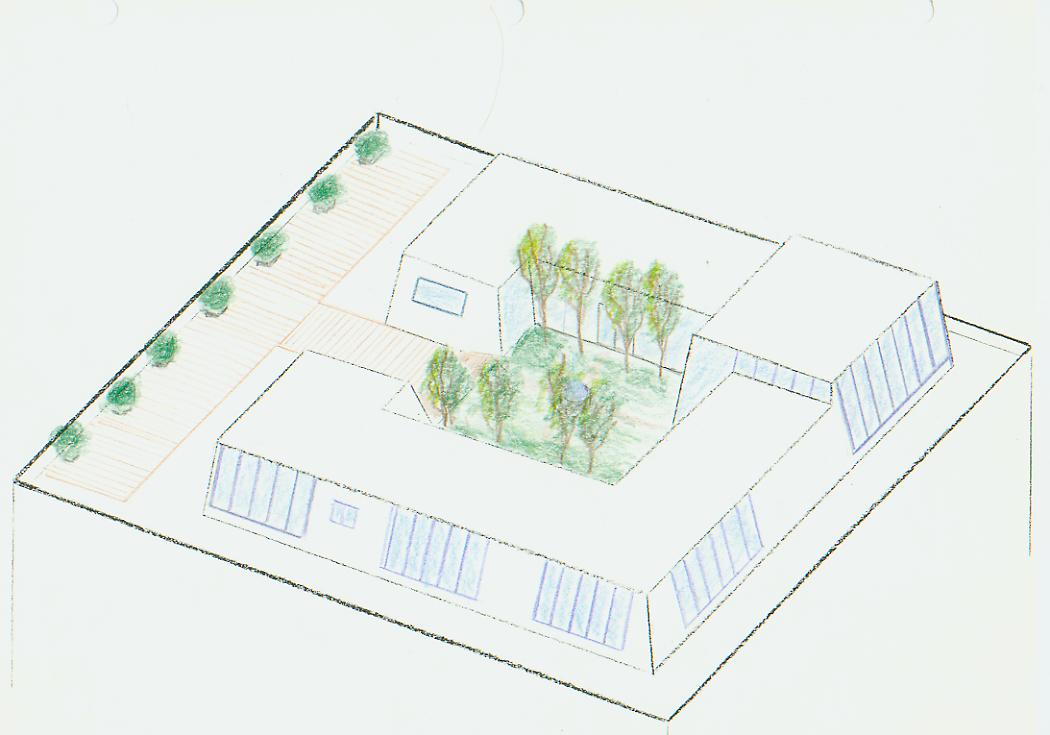
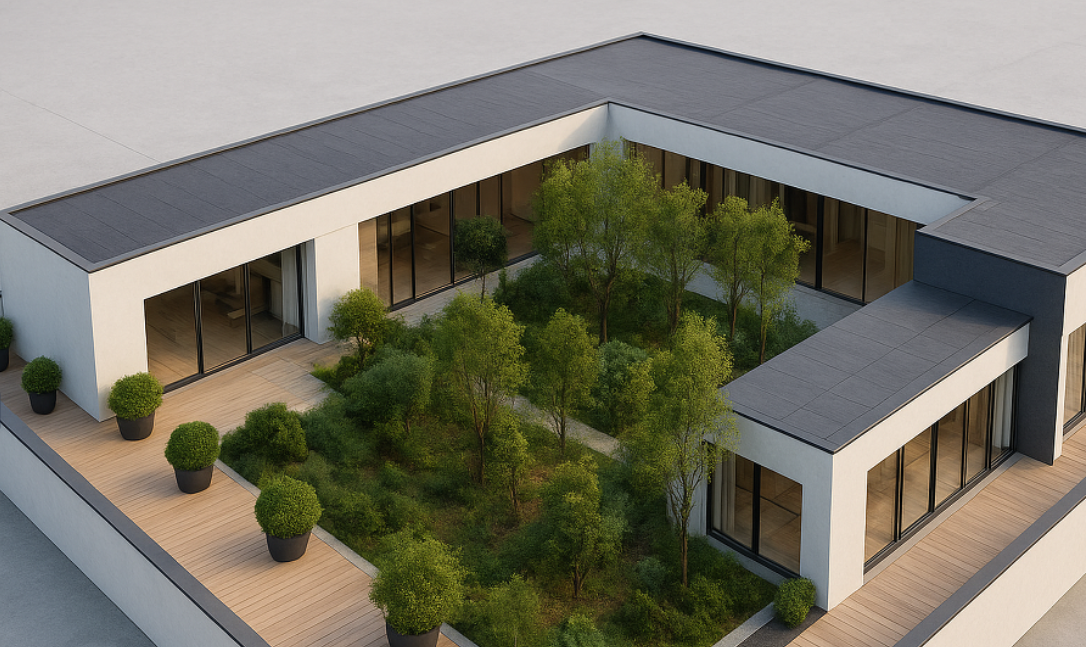
I wanted to use an ancient Roman idea for the penthouse: have a central garden with the house surrounding it, so that I'd have a quiet, non-urban space to escape to. This meant that the house would basically be "U" shaped, and I wanted most of the walls to be glass, so that I could see either the city or the harbor easily, as well as the inner garden. Here's an early sketch, and a better rendering without the design details:
| 
|
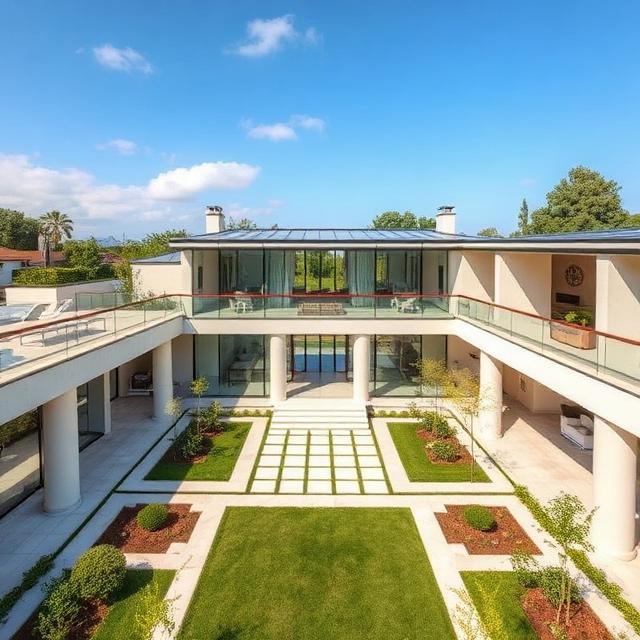
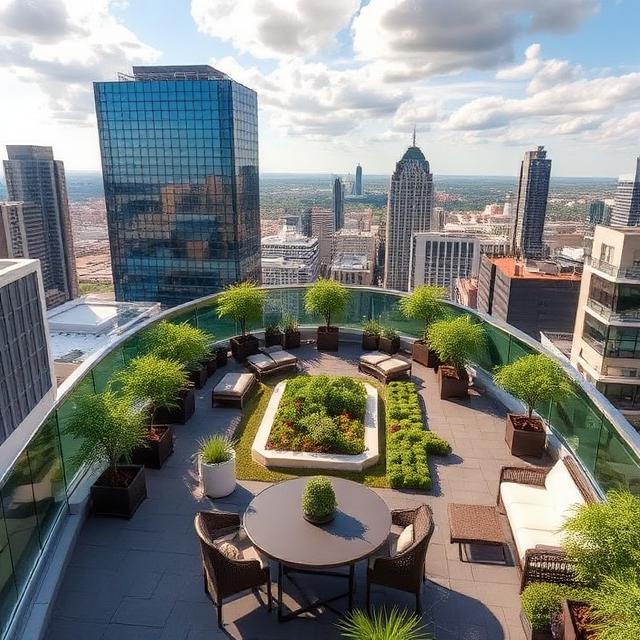
There could be quite a few variations on this basic idea, depending on the structural elements beneath. Here are two photos that might give a better feel for what parts of the structure might look like (I'd have a much richer central garden, and these aren't in an identical context):
| 
|
The larger bump on the upper right (in sketch, and in floorplan below) was to be the living room, and that (upper, right) side of the house would be the more "public side". The (lower, left) part would be the private side, containing a library and two bedrooms. This plan is pretty minimal - basically a two-bedroom residence. I expect in reality, given the time, effort, and costs involved, it would make more sense to have a larger, perhaps multi-level structure. A roofdeck, or walk-around deck, might be nice additions.
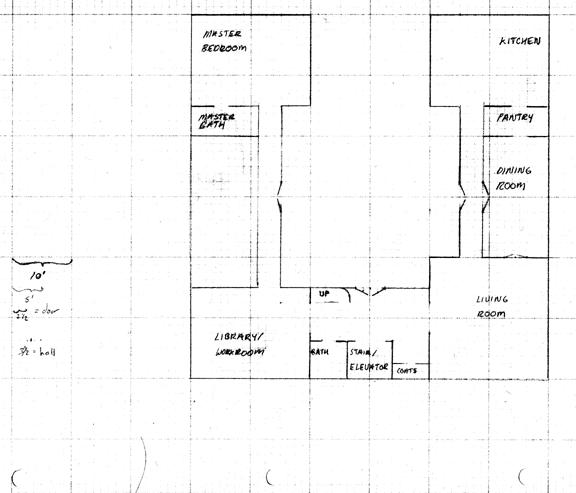 In
this plan sketch, you can see the master bedroom at one end of the private wing
(top left), with a private bath. Below that would be a second bathroom and
second bedroom, then the library at the bottom.
In
this plan sketch, you can see the master bedroom at one end of the private wing
(top left), with a private bath. Below that would be a second bathroom and
second bedroom, then the library at the bottom.
One would enter the penthouse in the bottom center via elevator, and either move left through French doors into the library or right into the living room (or straight ahead into the garden). The kitchen and pantry would be at the end of the public wing (right, top). I might add a bathroom where the pantry is, and moved the pantry, so that guests would not have to venture into the private wing.
Hallways would run along the inside of the garden wall, with doors in the center of each side. At the top of the drawing would be an outdoor deck, perhaps with a canvas tent over part of it. The dining room would look south over Boston harbor. I'd have wanted a fountain in the center of the garden, in part to mask city noise, so that it would be an area which would be very un-city-like. The garden should be a substantial one, with lots of greenery - to rest the eyes, and provide a sense of escape. part of it, perhaps near the kitchen, might be enclosed as an attached greenhouse, containing orange trees, lemon trees, coffee plants, and aromatic flowers year-round.
I pursued this as far as I could; I found the owner through municipal records, and I hired an architect and a lawyer; we could not put a deal together with the owner to make it happen, and I ended up buying and remodeling a condominium at 483 Beacon St. in Back Bay.
I still think it would be an excellent idea, although now that I'm married and have kids I'd have to do something slightly bigger - perhaps two levels for some of the structure. I might also enclose the garden in glass (e.g. a greenhouse), so that the space could be used and enjoyed during the winter months. And we're no longer in Boston.
Note that this basic idea could be stretched and modified in a number of ways - even if a roof was "stepped", something like it could be made to work.
A Modern Hanging Gardens of Babylon
It may be obvious by this point that I like greenery in and around my living spaces. While the above ideas involve external greenery, it may be far more interesting to bring it inside. One prod that got me thinking along these lines was a visit to a nearby greenhouse complex - the sound of the ventilation fans, the aroma of the moist earth and the plants and flowers themselves, suggested I'd like to hang a hammock there to nap, or have an adjacent (in some dimension) work area.
When I was a kid my imagination was entranced with what I imagined the Hanging Gardens of Babylon to be. Here's someone's fanciful recreation:

After spending a number of years in cubicles, I sketched out an office building using some of the ideas I'd had. I was tired of looking at walls, I love greenery and natural light, so those were the themes.
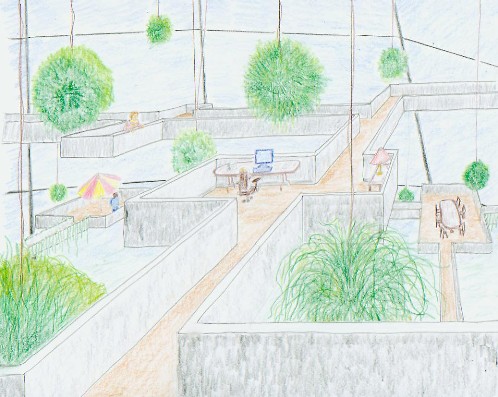
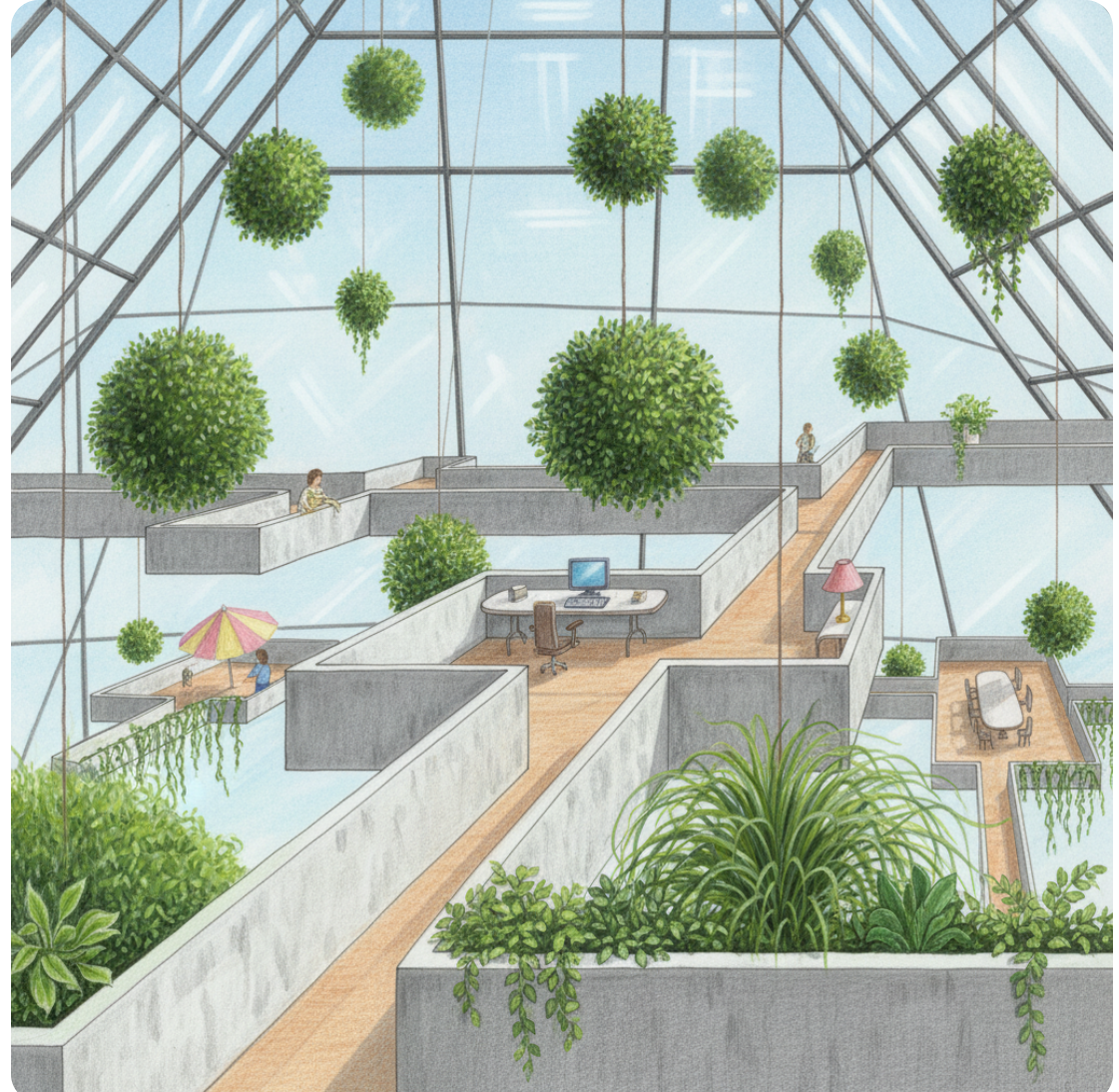
The central idea in the building was that each office is a concrete square with waist-high walls, connected by walkways with similar walls, suspended in a large glass volume - with plants above, below, and on all sides. Sitting at your desk you'd have natural sunlight filtering in through the plants.
 |
|
|
|
| |
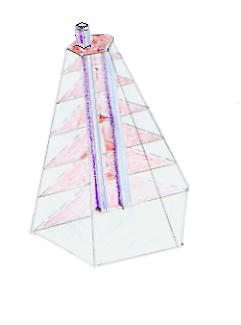
On the short side of the pyramid (in the back in the sketch, in red) would be regular floors, perhaps going up to 20, with elevators (the blue/purple columns in the sketch) and utilities and standard offices. This would be fairly conventional to design and construct, and would provide all of the basic services the building would require.
On the long side of the pyramid would be the open space: each floor on this side would be composed of a concrete and steel cast of walkways and office squares (with partial walls as handrails), as shown in the sketches above, taking up only a percentage of the possible floor area. With these in place, the long side of the pyramid would be mostly open, into which volume plants (with watering hoses, etc.) would be hung. The concrete cast hallway and office frames would be designed to allow appropriate vertical column support from one level to the next. The walls on this side would primarily be glass, likely with portions that might be opened, and with internal shades that might be activated as needed.
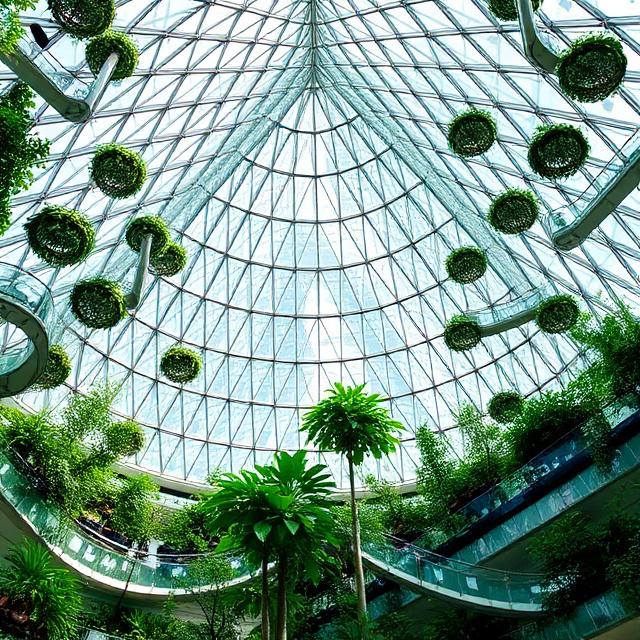
Here are two images of the type of open space involved, without any structural elements in the space, and with far less greenery than I would wish:
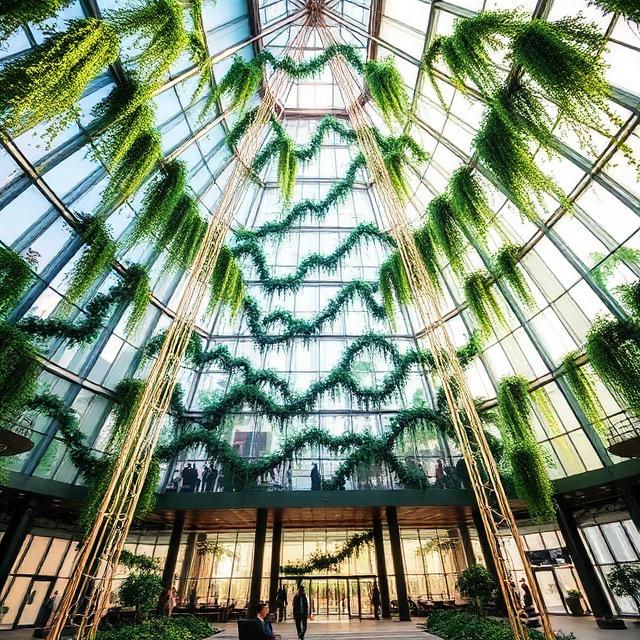
| 
|
So, to go to work, you'd enter in at the ground floor (probably a very open lobby, with shops, etc.), take an elevator up, and then walk out into the open space on a walkway to your office space. You'd feel suspended in space, though not so much that it would be fear-inducing or unsafe, and there would be greenery all around, giving you the sense similar to that of sitting in a tree, not suspended in open air.
The plants would also act as acoustic elements, cutting down echoes and noise, and would of course provide visual privacy. If selected properly, the plants could substantially improvements air quality - here's a ted talk by Kamal Meattle on how just 3 common plants helped clean up air in a facility at little expense: How to grow fresh air.
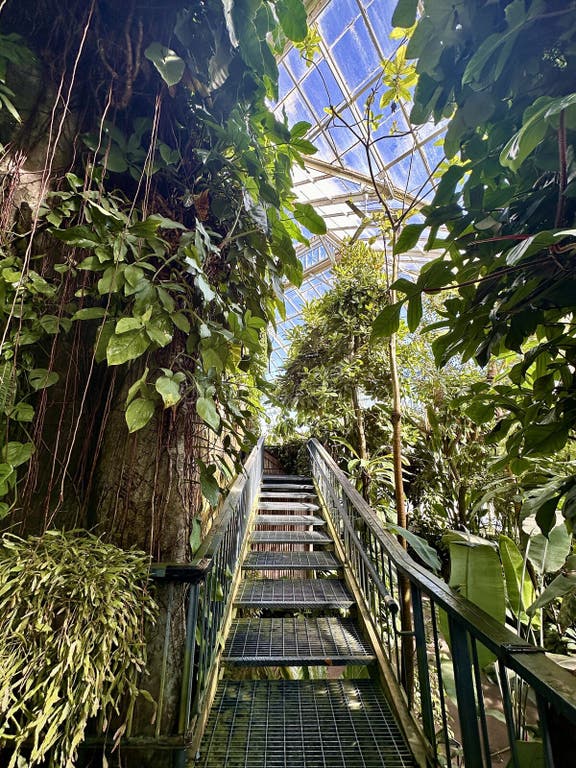
Here are some photos of far too dense vegitation, but they might give some feel for what is possible - though there wouldn't be an internal staircase as in the middle image, these are all within a glass building. The third image would likely (but not necessarily) be at the ground floor:
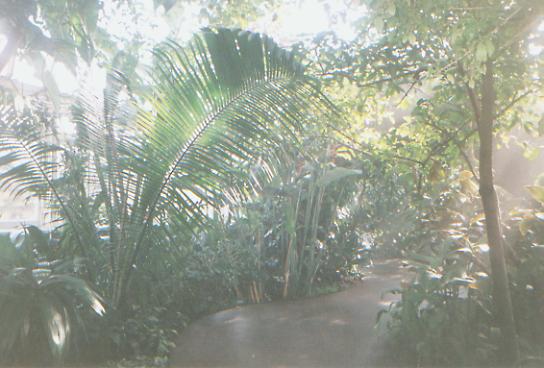
| 
| 
|
Solar heating would likely be significant, so this might be ideal for a colder climate - though shades (either within the windows or inside) could be adjusted as needed, likely automatically. Natural venting and air circulation should result in this be a fairly healthy building. To top it off, I'd slice off some of the very top of the pyramid, creating a deck with outdoor café (not shown in diagram).
This is by no means a 'plan' - it's an idea, which may be adapted by changing the size, building it on the side of a hill, using other shapes than the pyramid thought,
Naturalistic Shopping Malls
I'm tired of walking through malls that look like, well, malls. I'd enjoy designing one that had the feel of small villages scattered through a forest, with curving paths, small hills, bridges, streams, and some greenery. Lots of greenery, as a visual and psychological break between mall areas, even if they're close by or even within sight. Paths wouldn't just curve along one floor (if there even were such a thing, but also moving gently up vertically. Some of these platform-and-path vertical and horizontal sets might be intertwined, though a visitor may not be aware of it.
Of course practicality dictates that little space should be wasted. However, just moving from the rectilinear layouts of many malls would help. Instead of vast straight and flat hallways (I'm not sure what to call these internal avenues), it should be possible to add curvature, both left and right and up and down, with overpasses and spiral ascensions to higher levels. This might even eliminate the need for additional handicapped access, though I expect there'd be elevators at strategic locations.
"Villages" would have a higher density of shops and a greater number of small lanes. Each village area would have restrooms, restaurants, etc. Between villages would be spaces with lots of greenery (likely covering utility piping, wiring, etc.), perhaps fountains or small streams, large skylights, even fresh air intakes - along with places to sit down. These interruptions in the flow of stores wouldn't have to take up much space - they should be logical barriers, dividing villages or areas with different aesthetics.
It might seem that space would be wasted, but perhaps not. The vertical spacing might make wiring and plumbing simpler to plan, install, and maintain, and parking might be integrated under the structure, so that customers could drive closer to their destinations (both horizontally and vertically) than with current malls. An entire mall might take up less of a footprint on the ground, as it would use more vertical space than traditional malls - this would reduce heating and cooling costs as well.
While malls seem to by dying, the same idea might work for casinos (as they limit natural light, so people lose track of time), so the artificial greenery areas (with artificial sunlight) might be very nice. Casinos also seem to be very densely occupied, so perhaps that wouldn't work, unless it's in their associated and attached shopping areas.
Pool Magic
It's a simple idea to visualize: a swimming pool shaped as the bottom half of an ellipsoid of rotation. An ellipse has the property that a ray from one focus will reflect off of the curve and arrive at the other focus; every such path has the same length, so that energy introduced at one focus will arrive coherently at the other.
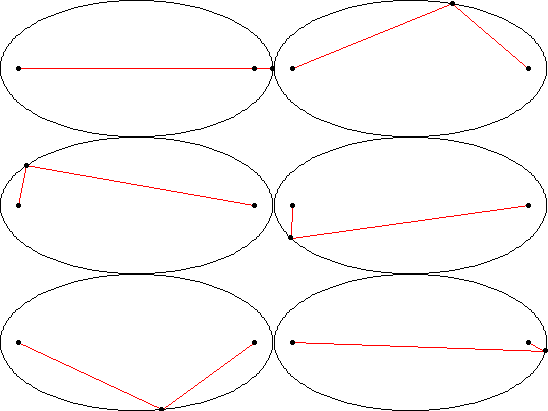
And, roughly in cross-section, sliced in half so that one half of the ellipsoid of revolution is the pool, showing the energy paths moving from one focus to another:
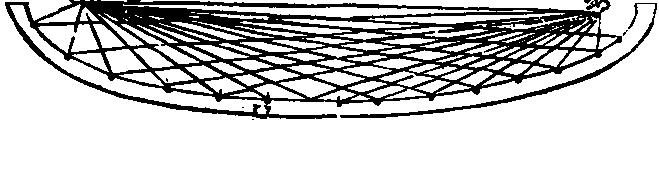
Now that seems fairly flat, but one may have ellipses much closer to "pool" shape. The limiting case is actually a half-sphere, in which case both foci are at the same location, at the center.
The concept is to design this swimming pool so that the diving board at one end would cause the diver to land at one focus. The shock wave from him hitting the water should propagate to the other focus, and cause a resulting upsurge in water at that point. As that water falls back, that should again create a disturbance at the diver's original point of entry, and so on, in an oscillating manner.
Adding further interest to the observer is the fact that surface waves propagate at a different speed than the pressure front through water does - so that the two forms of energy will arrive at the focus at different times, and may give rise to a "beating" phenomenon, as the oscillations of the pressure wave reinforce or cancel out the surface wave oscillations.
The presence of the diver in the water will probably interfere with the oscillation and cause it to become unstructured fairly quickly, unless the pool is large relative to the diver; experimentation is probably the way to determine what a good size would be.
For maximum effect the pool should be a rotated ellipse. But there may be partial ways to do this, for instance having the "footprint", that is the surface shape, be elliptical, with a more traditional shape below water. The surface waves would then show these effects, but likely in a far more limited way.
If anyone tries this at any scale, I'd be very interested in the results. I may do some small experiments with my kids, and if so I'll post the results here.
Better Corn Mazes
I've always loved mazes; I used to design them on paper, going so far as to have 3D mazes over multiple pages. When I was drawing them years ago, I evolved a few mathematical metrics about the maze branching factors, length you need to go before you can determine that you're in a dead end, and so forth. These had little practical utility in anything but designing mazes.
However, trying to solve a maze isn't that interesting: often you just have to make a blind choice, with no clue as to which alternative is the better or best one. This gets tiresome after a while.
Nowadays "corn mazes" are showing up, which are large mazes you walk through. It's sort of fun to be disoriented a bit, and if lots of people are doing the maze, you can compare notes. Some mazes have themes: one I did was even shaped like a whale. But the basic problem remains: at path intersections, you just have to guess.
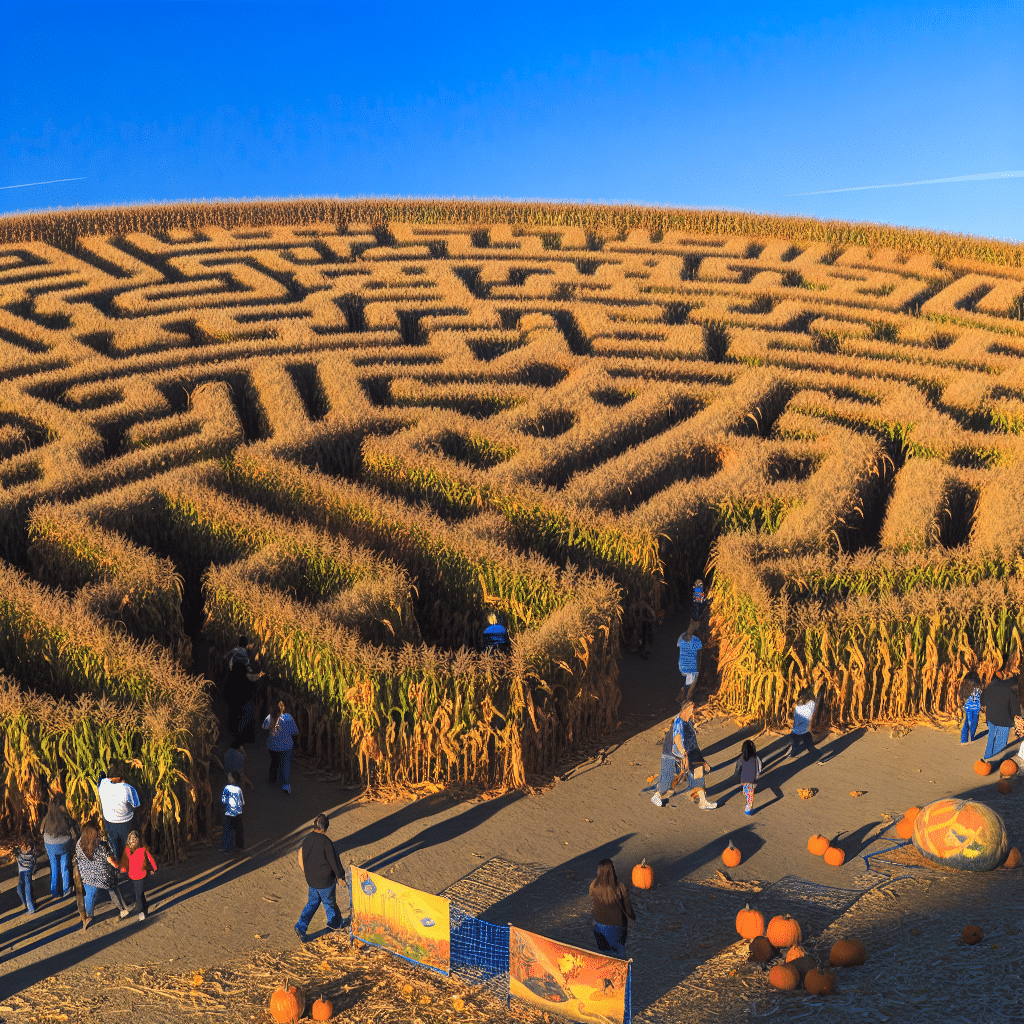
My idea is to post questions or statements at these intersections, with the answer or veracity of the statement to be used as a clue as to the direction to go. So, such a statement might be: "Ice made with Deuterium instead of Hydrogen sinks in liquid water" - if you agree, take the right path, if you disagree, take the left path. Mazes now might really have themes: science, trivia, history, and so forth. Call it "Trivial Escape" rather than "Trivial Pursuit". Dead ends might have notes on what the correct answer is and why; the participants might actually learn a tiny bit while doing the maze.
A likely better way to do this is to post numbers at the intersections, and hand out sheets with the clues. In this way, the same maze may be used for different age groups and topics.
If you have such a maze and want to use this idea, please go ahead. I'd appreciate it if you put something in the fine print that mentions me, but I'll leave that up to you. If you do it, let me know how it works out.
Restaurant/Bar with Train Delivery
I was in a crowded bar in South Boston when this occurred to me - one orders (perhaps in some semi-automated way), and your food and drink is delivered by G-scale or possibly slightly larger trains. There'd be "long haul" routes to the back of the restaurant, then switching down to "pier-like" fairly dense seating. Cars would have bar codes, there'd be scanners; restaurant staff/bartenders would fill orders and place in cars, a switching yard would make up the trains, and off they'd go.
It seemed like just a playful thought, but it turns out it's been done:
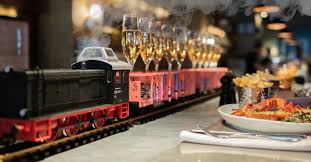
Several other locations:
Architecture for a Thousand Years
Now anything with a time span of a "Thousand Years" unfortunately brings to mind a nasty German political/military leader of the mid last century Please put that aside.
The key thought is to design for the long-term. Either a building is built to last as built (and there are a more than a few around of that age) or perhaps more practically are designed for easy maintenance and reconfiguration. For instance, a solid steel frame with exterior facades that are effectively replaceable - this to work of course has to be cheaper than just tear-down-and-rebuild.
There are reasons to build for the short-term: it's all one may afford, earthquakes or other natural major events are relatively common, and the building's use is for a defined time (a temporary military base for instance). However, it often seems that, even in cases where people are spending small fortunes on houses, and the houses are likely to be around for quite some time, they're designed and built to be almost deliberately "throw away".
It may be that building for the long haul is more appropriate to government or institutional buildings, but even there now we seem to be failing. In our town it seems like we're frequently abandoning school buildings to build new ones.
Beyond the basic idea, what would this mean in practice? By analogy to software design (odd, but bear with me), one wants a clean and sound basic architecture - well-documented, easily readable code, using established modular components that may be replaced. This is the nearly unchangeable core. Now of course computers change - what ran on mainframes now runs on desktops, phones, and even some TV's. Who knows what the hardware platforms will look like in the future. But those are 'edge' issues, parts of the system that have defined functionality that may be (in the scheme of things) relatively easily replaced. Doing those replacements should have little to no impact on the core.
Another analogy: military aircraft. A number have been designed to make maintenance simple, e.g. by making the components most likely to need testing, repair, or replacement easy to access. There's no reason not to take the same approach with buildings: make the most maintenance-heavy components easy to access, allow replacements of major components (facades, windows, elevators) to be as convenient as possible, and have a core skeleton that can handle stylistic and other modifications without requiring major rebuilds.
Conflict Database
When reading about the Battle of Thermopylae in Greece, I found in one source that archaeologists have identified nine different battles that occurred there. It got me thinking.
Part of this ties into travel information. I recall traveling back from a meeting in Charlottesville, VA to Washington DC with some coworkers. We went by roadsigns to nearby sites such as Spotsylvania, Brandy Station, Chancellorsville, Fredericksburg, etc. They had no idea what these names meant, having (apparently) absolutely no awareness of the Civil War. I realized that I, too, often travel in areas without knowing what conflicts happened nearby.
So the simple form of the idea is to have a web-accessible database of battles, across history - with lat/long as well as is known, and 'crowdsource' this project to let those who know the detailed history fill out decent maps, descriptions, personalities, casualties, and outcome. Of course, each battle is (at least in modern times) tied to a war, so there'd be a database of those. These seems like a kind of mundane exercise in just summarizing known history - but it might well be useful to those finding artifacts, e.g., near nearly-forgotten Viking engagements, and of course could be used to provide information to travelers and tourists.
I did begin to construct this, only to find after a point that there is a lot that's just unknown. Not only ancient engagements, but minor ones in even recent wars. I'm sure in nearly every modern case there are people somewhere who have information, but it may not be well-recorded, and is at risk of being lost. And archaeology sometimes discovers battle sites going back a thousand years or more, but has no record of what war they were part of - it seems like that should raise a number of questions deserving of answers. Often the rough date of the engagement may be determined by the technology of the weaponry, or other archaeological clues.
On the other side of that coin are the famous battles with unknown locations: the precise location of the Rubicon crossing, the Battle of Cannae, the Battle of Badon Hill, Agincourt, and others - including some of those of Alexander the Great. Part of the value of having a database is that, if artifacts are found, it may tie history to geography a bit more closely.
TimeLine Software
Now with a grandson with us I may have to resurrect this. It was a software system I wrote a number of years ago, that would construct 'timelines', several per page (and it could create multi-page outputs). One for instance might be 'history of the universe', another 'history of earth', 'history of life', 'evolutionary periods', 'human recorded history', 'the ancient world', 'US history', etc. Each allowed text with precise markers on the horizontal colored bar, which might have regular units (millions of years, thousands of years, hundreds, tens), along with the inclusion of imagery at various points.
The example below isn't mine, and just shows one line, while I allowed several horizontally-parallel ones for related topics.
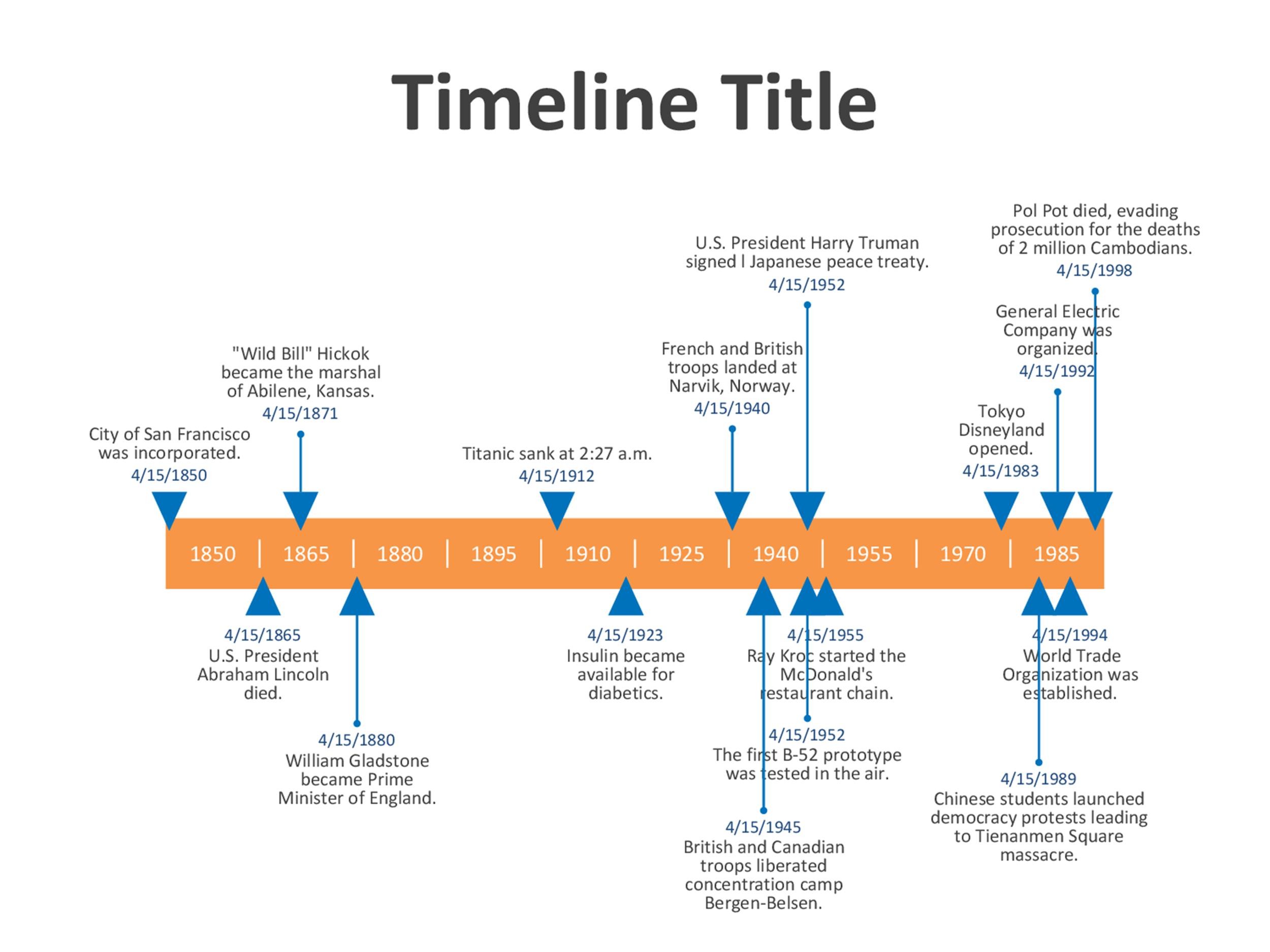
The output was then editable - I'm not sure what format I used then, one might use something like Microsoft Word now (as it's well-known, and can handle different types of data), or more graphically-oriented formats.
Fading Photographs
I wrote a bit of software to do this - but, to show historical structures to kids who were familiar with their modern versions, I wrote a tool that would allow a user to identify the same points in old and new images, then solve for the transform that would map one to another. I used web fading techniques to move back and forth:
The Quiambaug School, now a private home:
![[Loading...]](./ideas/real1.jpg)
![[Loading...]](./ideas/ghost1.jpg)
Historical Faces
This concept is a lot more practical now, and I'd kind of be surprised if it isn't done soon, if it hasn't already been.
Probably a website: you upload a photo of your face (maybe several - straight on, profile, 45 degrees). The facial recognition tools fire up, and give you a resulting list (not all of these at once, these are just representative examples):
- You have the same eyes as the artist Rafael;
- Your nose is very similar to George Washington's
- You have the same cranial structure as Julius Caesar;
- You are the spitting image of Napoleon Bonaparte.
There are websites that will show you celebrities and people from the past whom they resemble. Some are very striking. It seems like there are a few that will show you some historical matches to your face, or to individuals depicted in paintings.
I spoke with my daughter Genevieve about this years ago - after one Princeton class she remarked that a number of ancient sculptures of individuals were somewhat generic, as often there was no original imagery or even description to work from. So if you're matched to, say, Homer, it's likely not very accurate.
Fun Kid Dinners
Having three kids, dinners can be a challenge, especially when they're on the young side. Fortunately (or by careful training) our kids eat a large variety of foods, so it isn't simply a problem of menu choice. Rather, at the end of a long day, when my wife and I are tired, it's nice to have a fun family dinner, rather than just a meal. Here are some ideas that have worked for me. The goal is not to be expensive, exotic, or fancy, but rather to create memories for the kids, and to make dinnertime fun. It's amazing when it works.
As this section has a number of subsections, I've moved it to a separate web page here.
Shrimp Server
I used this custom-made shrimp server one Thanksgiving. Image an Aussie accent: "I heard you were coming, so I threw some shrimp on the barbie":
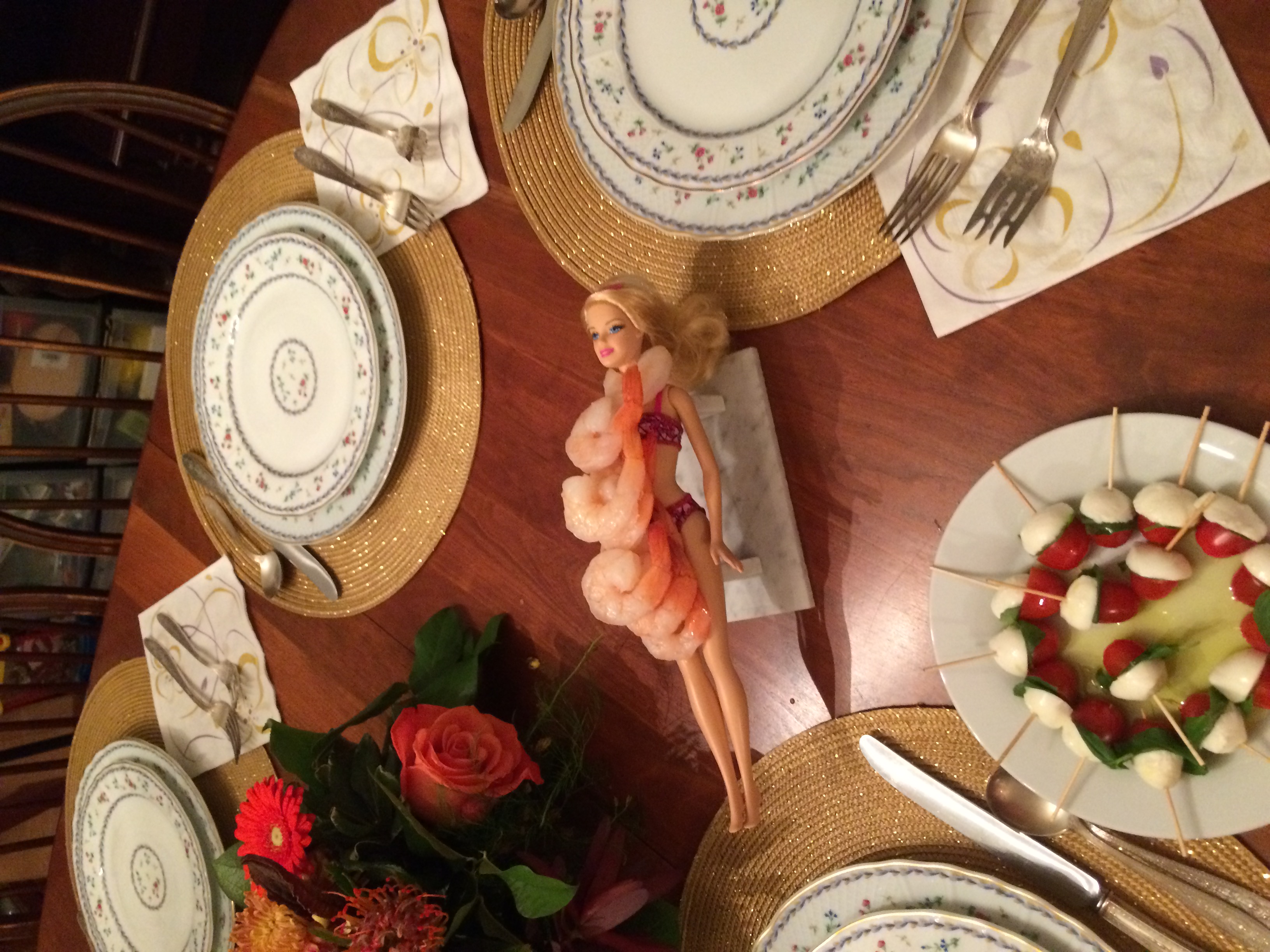
Air Food
Airport restaurants are generally pretty bad. The food choices are minimal, the staff seems to be surly, the clientele is preoccupied with coming and going, when not zonked by jet lag. Only travelers are around, because no one else has any reason to face the hassles of getting to the airport.
Now people do travel to grubby waterfront areas to eat seafood. We've all been to restaurants on wharves, decorated with nets and lobster pots and so forth, which create "atmosphere". Sometimes the food is great too. So if people go to seaports to eat good seafood, why not establish a new class of restaurant, so that people go to airports for airfood? (Of course, now with airport security being what it is, this might best be a restaurant outside of the airport, just nearby; or, it might be an attraction inside an airport with enough traffic to justify it.

| 
|
Now I don't mean the oxymoronic "airline food". I mean "Air Food": ducks, quail, geese, squab, and other denizens of the skies. This is a missing culinary category in America. I'd really love to find a place that specialized in fowl and did it well. Dishes might include boned quail with raspberry glaze, roast goose (possibly with a sauerbraten-like gravy, or oyster stuffing), duck a l'orange, and pheasant under glass. If the menu were extended to the now-earthbound, it would include chicken dishes, emu, and turkey, among others.
The fois gras alone would be worth the trip.
With modern diners more health-conscious than ever, this could be great. It would be novel enough to attract patrons, with a durable theme that would not fade. Some airport restaurants might host fairly formal places, with a subdued decor along the hunter line, while others might take it more lightly with a bit of humor (e.g. "Turbine Engine Paté of Pheasant", "Propeller Stew", "Runway Special of the Day"). In any event I wish someone would go this route, so that I'd have someplace decent to look forwards to when traveling.
Soda Vintages
I thought of this when I was quite young, in the kitchen, while my parents and my aunt and uncle were in the dining area, talking about wine vintages. It occurred to me, then quite naively, that maybe sodas should also have vintages. Having then seen the "New Coke" failed launch, the idea came back.
So, take Coke, but as a generic example. A 'vintage' would be a dated small variation in flavor, produced, canned/bottled for just that year. Of course 'regular Coke' would still be available, so there'd be a slight price increase. One aspect would be that it would allow Coke to experiment with flavor variations; another is that people might build memories (first date, etc.) around a particular 'year'.
Of course soda fountains and the like could produce pretty much anything any time, and Coke itself might re-issue limited edition runs of its more popular years.
It's all really a marketing idea (beyond the value of flavor experimentation). As with Beaujolais nouveau (also a marketing gimmick), people might look forwards to the introduction date, there's be taste reviews, and so on.
A New Sort of Restaurant: "Micro Catering"
Long ago I worked a little in restaurants, and more recently I read the book "Kitchen Confidential" by Anthony Bourdain. What struck me was clearly one of the themes of the book, that work in a restaurant kitchen is driven by the need to produce quality output rapidly and efficiently, while coordinating different chefs working with different materials. Add to this the need to coincidentally time the delivery of all dinners to the same table, and it becomes quite a juggling act.
While there is no obvious problem here that can't be overcome, the inefficiencies in this process (and attendant panic, and waste of materials) seem to cry out for something better. Here is one idea, which might be used gradually or completely within a restaurant.
The idea is to have patrons pre-order. Now this wouldn't work for all restaurants, or even a majority of them, but for very fine dining it might be very well received. For example, if I'm going to be meeting with a client in a high end New York restaurant, I might want to peruse the menu (which could be vastly expanded; more on that in a moment) beforehand, and pick the courses which I'd like, possibly different for each person in my party. I walk in with the client (who may have provided preferences, or may have placed himself at my mercy), and we are discreetly served as we talk - no need to fuss with menus. Presumably I'd pay in advance as well, relieving the wait staff of the task of collecting the money too.
What does this do to the restaurant? Well, now they know exactly what to order, and don't have the problem of either running out of something or of buying too much. They also know when my reservation is, so the precise use of kitchen resources may be planned in advance. So: practically no waste of materials, and vastly reduced stress for the kitchen staff.
What does this offer me? Well, it is a much different sort of atmosphere than a usual restaurant is; in fact, without the menus and check, it's almost as if I'm being served at home. More importantly, the restaurant doesn't have to restrict its menu based on the ingredients that are at hand that instant - it ought to be able to offer a much wider variety of choices, as there will be appropriate time to acquire the necessary ingredients and prepare. So I would expect to see a wonderful set of options, and the chefs might enjoy their work more too - more variety, less stress, more focus on the art than on the "crank-it-out" mechanics.
There is no reason this idea has to be all-or-nothing. There still might be specials, and some provision for walk-ins. This breaks the purity of the 'pre-order and pre-plan' idea, but it doesn't have to be perfect to make life much easier and more pleasant for all involved.
I term it "Micro-Catering" as it's as if every party in the restaurant has specified things much as one does when planning for catering for a large group of people.
A Cookbook In Bad Taste
I've thought about writing a sort of odd cookbook, one which would amuse as much as provide recipes. The idea would be to offer menus appropriate (or inappropriate, depending on your point of view) to certain holidays. Here are some of my ideas so far:
Groundhog Day (Feb. 2): Ground hog, of course: perhaps pork pie;
Valentine's Day (Feb. 14): Stuffed hearts of beef;
March 15 (the Ides): Caesar Salad, perhaps with chicken to represent Brutus et al;
Easter: Bunny (rabbit) in mustard sauce;
Cinco de Mayo: Something with 5 types of mayonnaise;
Arbor Day: Hearts of Palm salad;
Independence Day (July 4): Steamed Lobsterbacks (lobster tails; a nickname for British troops at the time.)
Bastille Day (July 14): Let them eat cake.
Christmas Eve: Reindeer steaks.
Well, you get the idea, such as it is.
Shopping Lists
Why don't food stores print up and make available blank shopping list pages with categories in the order in which customers will walk through the store? If you walk into the Produce section first, then that would be the first category on the printed page (the page could indeed look like a map with named sections).
This would help guarantee customer loyalty, as if your list were on a page for a particular store, you'd be slightly less likely to shop somewhere else.
For the customer, it's convenience: your list is in the order of your travel through the store, so you get everything on one pass.
I find I actually do this during holidays - I create an Excel sheet (the easiest thing to write a list in and then sort), I list items, the section of the store, and sometimes the dish (so if a key ingredient is missing I don't get all of the others). Then I sort it by store section - I number them in the order I walk through the store, so I can use this approach for any store - and it means I can shop in one pass. During holiday time, When there are many people shopping, and many who aren't 'regulars', so they leave their carts blocking aisles, etc., the efficiency is noticeable, to the point of actually being relaxing.
An example, after sorting: I usually enter items by dish, then do the sort by part of store after I have everything present:
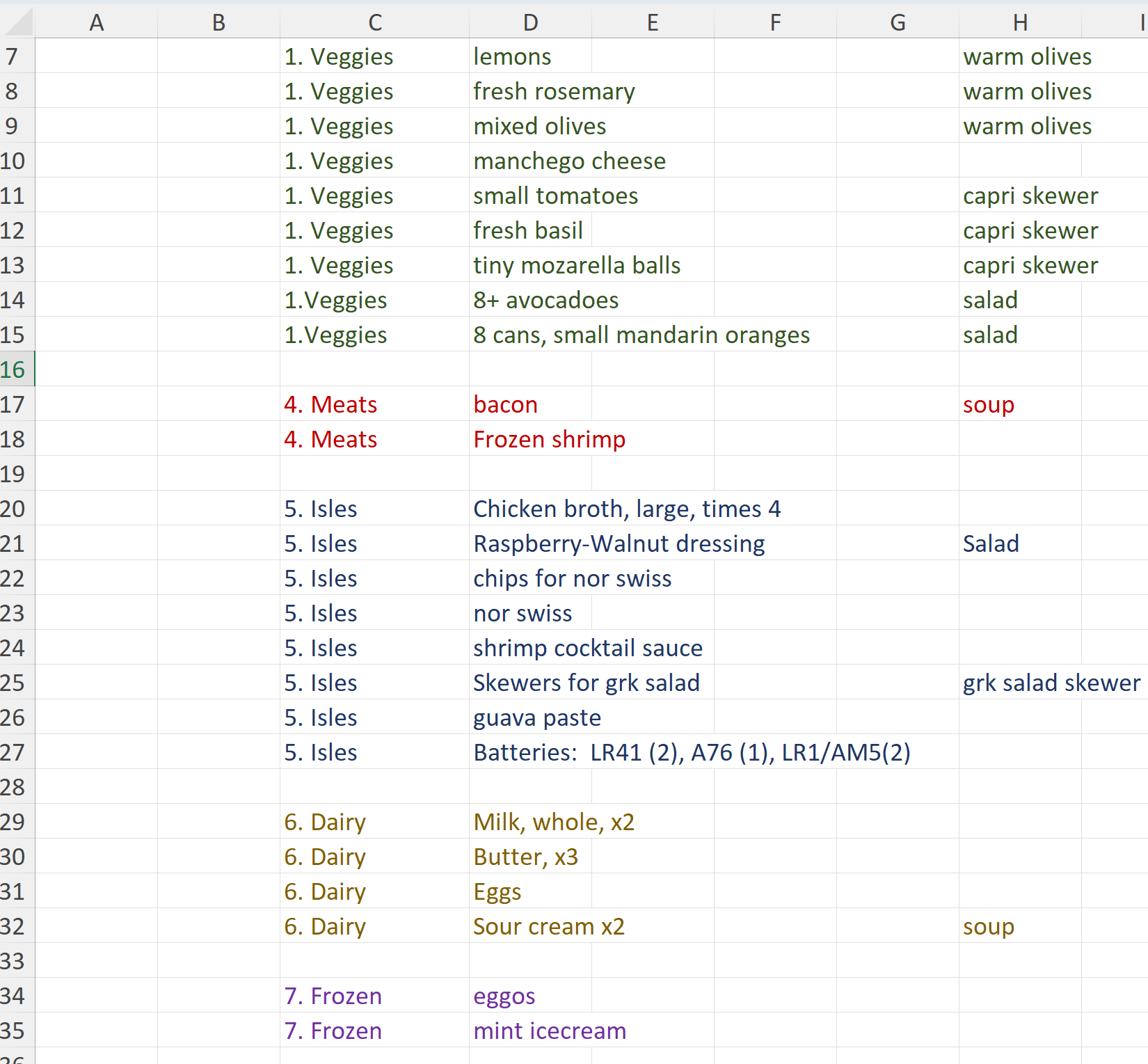
I have a lot more in this category that won't land here, as I might wish to proceed with them at some point; however, the older I get the less likely that is for the more time-consuming projects. I will try to be almost telegraphically brief in my descriptions.
Directed Theatre and Travel Service
I love live theatre, and have favorite playwrights and actors. For years I thought about creating a low-overhead business, focusing on Boston, New York, and London.
A customer/member would sign up, and list their generic travel preferences and interests (actor, playwright, genre, specific plays, conductor, composer, etc.). The system would routinely look at matching upcoming performances that fit, and notify the customer. The value here is that, if for instance I were traveling to New York or London to see a performance, the business now has a motivated customer that will be traveling to a specific location within a specific date range.
The whole point here is the economic basis of the business is customer-requested relevant advertising. Given the price points the customer has picked out, a 'curated' (overused word now, here perhaps meaning ones with current good marks and no bedbugs) list of specific hotels, restaurants, airlines, car services, etc. could be provided. For restaurants, links to menus, reviews, etc., might be provided in an unbiased manner.
For most of us most of the time advertising can seem like an unwanted and annoying intrusion; in this case it might be welcomed in a "info to help me do this" mode. Not only might web 'clicks' generate income, but some percentage of sales might be profit as well (Ticketron used to have a program along these lines, not sure they still do - if you sold through them, you got a cut of the sales).
Deep Travel Planner/Opportunist System
This started while traveling with others - we'd be somewhere, and I'd say "Hey, over there two miles is the Spotsylvania battlefield", or "There's a great French restaurant in the next town". This was pre-internet days, and much of my knowledge was based on reading history, food magazines, previous travel, friends' info, and the like. Now much of this is searchable, but who does? If you're going from Point A to Point B, do you really look at the locations, events, or opportunities that exist just off of your planned route?
In a way it's hard to do this sort of thing by hand because any individual may have many interests: cultural or military history, wines, foods, architecture, museums, family-related sites, and so forth. Part of a tool of this sort is building a collection of those interests, not just for one person but other traveling partners in the group.
Now much of this info is on the web, but again there's no effective geo/time based searching. (To clarify, the "geo" part is travel-path-based, not single location, and the "time" part is when you'll be passing through.) The time element is important - some of the more interesting experiences I've had (especially with kids) have been stumbling into festivals, fairs, or other celebrations accidentally. Searching community calendars is easily part of this too.
The tools are all out there to do this - I have one or two phone apps, something like "history near me", not sure what I have for events. But they all require that I specify where I am now; none that I know of take an itinerary and add commentary and suggest options - the kind of thing a local friend traveling with you might do. I'm not sure how the economics might work - I hate iPhone app subscriptions, particularly those that auto-renew monthly, but I don't think I'd mind one I could just turn on while I'm on a trip, and then turn off when home (or have an auto-turnoff, perhaps with confirmation). If there are ticket prices for admission to sites or events, maybe the app could offer a discount, and receive some cut from the vendor/site.
Emergency Planning Evaluation
I actually had a contract to write a tool of the sort I'm going to describe, for the U.S. Coast Guard, regarding oil spills near shore. Essentially it was a way to lay out all the things that would need to be done, or the equipment that needed to be available within a reasonable time period, and evaluate readiness - almost a kind of checklist, but several levels deep, and organized by category: manpower, equipment required, contacts with local authorities and the press. And not a simple checklist really, as there is usually a timeline with checklist-like items coming into play at different times.
It seemed to me like one example of what might be a very powerful general tool. I'm tempted to call it "Automated Worrying So You Don't Have To". Templates would exist for a wide range of occurrences - not just the somewhat obvious ones like house fires or predicted flooding or hurricanes (e.g., maybe make a checklist, including "get your key documents together", "make sure you have enough prescription meds", "plan for your pets", "have a destination in mind", "have a gathering place", etc.).
There are other events in life that require some forethought, and many are not emergencies. If you've never bought a house before (and even if you have, and it's been years) there are a number of steps, and the timing may have changed - how long will it take to get a mortgage approved? What's the lead time you need to book a mover? Probate planning is another, whether for yourself or elder family members. Some may be short-term, like having a "go bag" if you might be called on a quick trip for business, or to help family members or friends on short notice. Others are longer-term. Life has many many of these sorts of challenges.
I suppose one might try to shoehorn this into something like "Microsoft Project", but the focus is really quite different.
There are "checklist" websites, and for all I know probably books, but a simple software system or iPhone app (I use "iPhone" generically, Android is fine, etc.) that would help take the stress out of these situations, and qualitatively be better, as checklists have no depth. It would be more than a checklist - there would be action items with details, some reminders at settable intervals of things that remain undone, links to useful websites (weather, civil info, local hospitals, lawyers, financial institutions - ideally with some quality metrics). The problem with the "checklist" approach is that it implies there is a set of single steps that you need to take, when in fact most of these problems are "tree-like", in that they branch in different directions based on specifics (some of which may not be known in advance). It's having that deeper planning knowledge as one moves through a process that could be very valuable.
I'm not sure how to monetize this, I think of it as a software version of a friend who's lived through a given challenge a few times and can tell you what the options are for next steps. Indeed, even a social communication component to talk to people in the same situation, or who have been in the same situation, could be very useful.
For a corporate setting that manages or may be impacted by emergencies, this sort of tool seems a natural fit. If nothing else it would make sure that equipment is at appropriate levels, phone numbers and staff contacts at other agencies are up-to-date, and may also be used as the basis for "table top" exercises to familiarize staff with key processes and interaction points.
Computer-Aided Selective Breeding of Plants, Critters
In recent years genetically-modified crops have became quite the thing. On a visit to DeKalb Plant Genetics, at an open house we kind of stumbled on, the technology was explained - at least at the time they basically physically fired the dna they wanted into plant cells. Perhaps this was before gene-editing techniques had evolved.
On my mother's side I come from a family of florists (Siebrecht family, e.g. "Uncle Henry"). Finding or developing novel flowers was an important part of business, and I grew up with a number of stories about efforts in that direction. So quite a few years ago now I began, as an AI scientist, to try to figure out how one might develop an 'old-style' alternative to genetic engineering - not because I was a strong opponent, but because I find that sometimes going in a radically different direction can be a way to find unique solutions.
As one of my profs said, "The vast majority of AI problem solving is based on search." What he meant by that is exemplified by chess-playing programs. They don't have some greater intuition about the game, what they do is look ahead, looking at all possible future play moves, further than humans do. Now the combinatorics are horrendous, so there are some tricks to this to limit the search, and strategies to evaluate board positions (so one can say "If I get to board position A it's better than board position B). Chess has alternate moves, so if the AI system considers a move, it then considers nearly all of the opponent's moves, then all of its possible responses, as far as it can within time and memory resources. It doesn't 'know' the game really, it just out-searches human opponents.
So, could this be applied to plant breeding? Let's say I want to have a tomato with a particular riping schedule, a skin thick enough for shipping, a certain sweetness and seed density. If I have data on all current tomatos, and find exemplars with one or more of my desireable traits, I can begin cross-breeding them and testing the result to see if I'm closer to my goal. In a way it's not a bad analog to the chess playing AI; though in this case I want to find the quickest way to get where I'm going (more likely the set of possible paths ordered by likelihood of success). Due to the natural variations in cross-breeding I have to do a certain number of trials (which may be simultaneous at any step). It's possible I'll end up with a dead end, but a decent AI system could structure the search to be optimal, could lay out all of the likely workable strategies, and help guide the cross breeding by evaluating test results on the next generation.
One of my clients at the time knew one of the lead corn researchers at the University of Nebraska, and put me in touch with him. We talked, I described the idea, and he said (iirc) "This will definitely work. There's just one problem - the vast majority of data about current strains of corn is propriety, so you don't have much of a starting point."
I put the idea on hold for a bit, but also realized it applies to animals: dogs, livestock, race horses. The same problem crops up, and it turns out people also lie. In talking to one breeder he mentioned one new animal had a well-known genetic disease, but based on documentation of the animal's ancestry, it just shouldn't be there. So, to increase the value of the parents' sale or stud fees, someone lied somewhere.
For less economically-intense categories, like flowers, it still might well work. And, as we can now sequence genomes a bit less expensively, the lying or lack of open data may not be fatal problems. With real genetic data, AI 'searching' to develop optimal breeding programs may become a reality.
 |
 |
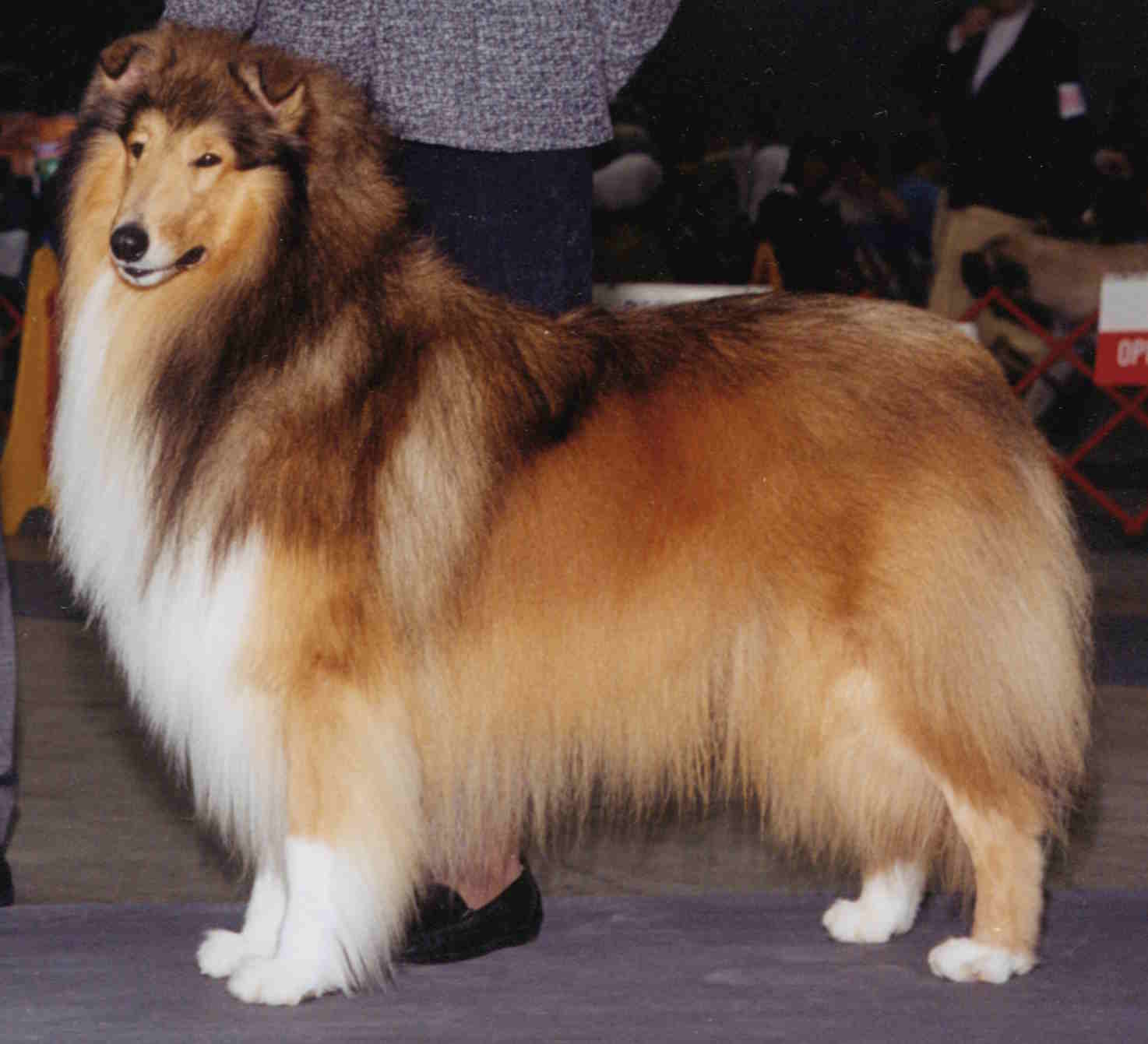 |
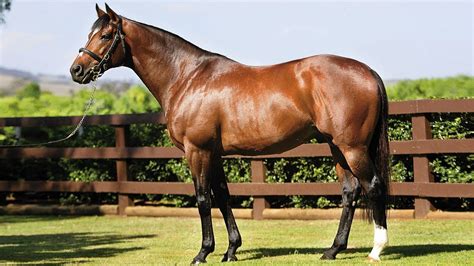 |
rose |
champion Collie |
Local and Personal Microclimate Garden Analysis
In times past, not that far back really, before seed companies created virtual monocultures in certain crops, farmers would develop what was known as 'landraces' - they'd choose some of the best plants from a harvest to use as seed for the next year (no hybrid seeds here). This led to improved crops, but ones which were both somewhat unique and optimized to their local microclimate. We unfortunately don't do this much anymore - which can actually be a problem if there's a pest or disease that targets a given monoculture, and can wipe it out. With landraces there was enough variety that there might be active resistance to that.
My thought was to build a software system to plan my garden, and manage it over the years. I'd start by entering what I planted; the system could grab the daily weather, rainfall, etc. from the 'net, which would be part of the profile. I could add in soil chemistry information, and pest info as well. Even the location on my lot, with the sun and shade from the house or trees at different daytimes could be factored in. Using this well-established knowledge I might be advised to modify what I was planting, fertilizers to use, or to test for certain conditions (soil changes, pests I didn't notice, whether my watering schedule was correct).
But more than that, if I entered results, the system might help me rapidly build my own landrace set, tailored to my very specific and very local conditions. It might help to think of this system as part 'accounting' system, recording planting and environmental data, and 'planning' system - it might suggest, say, that a given vegetable that didn't provide much yield should be attempted again, as that Spring's conditions were unusually bad for that plant, where if I'd just kept a journal I might give up on it. (Historical journals recording planting outcomes might also be brought in.)
Master Gardeners On-Call
One of our housekeepers was also a Master Gardener in Connecticut. She used to do projects for people on a contract basis, but as she got older she found the physical toil was just too much. It made me think that what she still had going for her was what she knew, far more than what she could do with a shovel or pruning sheers.
The idea was for an advisory service: a customer calls, with a specific problem or just wanting to know what plants might do well in what location. The service sends out a Master Gardener, who looks over the location, takes soil samples, and comes up with a set of options for the customer, who is then billed. The professional stays involved using his or her knowledge, and the customer gets critical advice that may radically improve their planting.
Beyond this service, the Master Gardeners might also provide oversight services. Landscaping businesses have a spectrum of knowledge - for some it's quite simple, mowing, cleanups, etc., others know and do more, but often they either don't know or won't explain the limits of their knowledge. Having an independent "project manager" that reports only to the homeowner and can provide expert oversight is worth paying for.
Point-to-Point Education System
I've kind of needed this system, or something like it. Even though I have expertise in some areas, some clients need something intellectually 'nearby'. Now that's been part of the fun of being in the independent role I've been in - having the time to dive into some new aspect of a field I was familiar with, and closely adjacent to what I know, to solve a client's problem.
Indeed a similar issue may come up while reading a technical paper in an area I've worked in. There's what I know, a number of new or just different areas I don't, and the paper may build upon those. I don't need to start with the basics, I want to start with what I know, and work out a reading/educational plan to understand all of the concepts the paper references.
What I'd like is a system (could be web based) where I explain what I know, and what I need to know, and have that system advise me on the intermediate topics I need to understand to get there, and what resources (readings, etc.) that may be out there to get there. This may be clearer by counterexample.
Many technical books are written assuming little knowledge of a field, and though they might contain what I need, I have to skip over much of the introductory material. This can, over time, begin to seem like an annoying waste of time - often for trivial reasons, for instance if the volume uses a particular (and sometimes non-standard) notation I'm not familiar with. Then I have to go back just to read those mechanical parts that really don't add anything substantive. Or, alternatively, there may be current expert-level papers in the field that are extensions of, or are built on, other recent developments I'm unaware of.
I started to work out how a system like this might be built, and began by looking up taxonomies of knowledge. There are dependencies of course: one needs to understand addition before understanding multiplication, functions before understanding calculus, calculus before understanding differential equations, differential equations before understanding (any of a variety of fields). This is true of most technical topics: Physics, Chemistry, Biology (though not an area of mine), etc. Somewhat surprisingly people have worked out formalisms to define these things. This structure would be the basis of the system architecture: I specify what parts of the taxonomy tree I'm comfortable with, and identify the elements I need to fully understand, and the intermediate steps then may be enumerated.
Part of a tree of topics and their relationships:
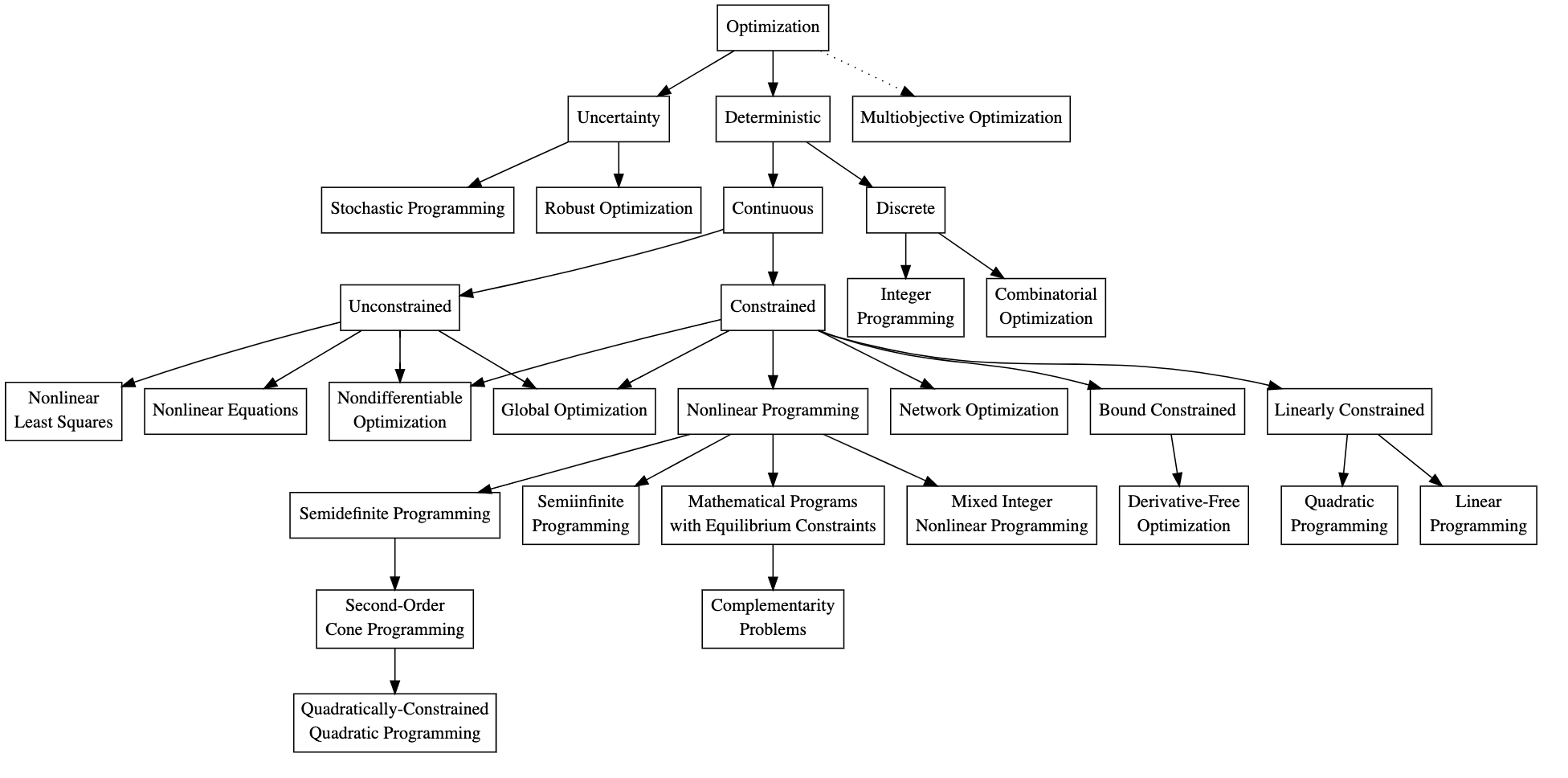
A complete tree/network of this encompassing physics, engineering, mathematics, etc., would of course be huge. But it might be built piece-by-piece by domain experts.
I think a variety of people, in a variety of fields and for a variety of reasons, might have use for such a tool.
"Rational Argument"
If you've ever been part of a web-based discussion, online in a forum of some sort, you've likely noticed it can be quite frustrating. Often the initial experts state their views, counter arguments appear, the points either for/against a position are jumbled, the experts gradually leave being supplanted by newbies, who restate things - and the entire mess leads to no enlightenment.
The idea here is to provide a structure for arguments - so, for instance, if there is a policy issue with two alternative solutions (say A and B), the positives for A would be grouped together, as well as the positives for B (and similarly the negatives, as subcategories under the main arguments).
This was a plan for a technical tool to assist a group of people work through a decision, policy, or argument in the face of uncertainty. The Method: identify the assumptions/evidence, work out the arguments and counterarguments for alternatives, arrive at a decision, and communicate the result.
- Keep argument/discussion in structured format:
- This lets new people quickly learn what's been said;
- Prevents redundancy, people restating existing points, though they may add subtleties.
- Scoring:
- Let's people find the most important points quickly
- At a glance review of 'shape' of an argument - the major points driving a decision or conclusion.
- Integrated Evidence:
- Relevant docs, etc. available as details of tree leaves;
- Changing assessments of veracity of assumptions may quickly percolate to new results.
- Numerical dependencies (e.g., the price of gold, or real estate) may be brought in dynamically to weigh for or against particular points.
- Outputs:
- Possible to generate an 'executive summary' outlining the major points (based on scoring), and the reasons (pros and cons) that a particular result is based on;
- The tree itself - may be used in bigger arguments, may be analyzed, patterns found, etc. Indeed there may be subarguments that are structured similarly, with results feeding upwards.
- Uses:
- Working towards consensus when faced with alternatives;
- Moving beyond the current (sometimes political) decision-making process;
The RAND corporation developed the DEPHI method to do something like this. Participants (including individuals such as Henry Kissinger) participated anonymously, so those involved would engage with the arguments themselves, and not be swayed by the status of any other participants. This may also be critical in a corporate setting, in which executives may not hear from the 'front line' sales or technical people about the risks and opportunities that exist.
In terms of implementing this system, it isn't that hard to get something working - I did years ago. I used a database system to hold the major statements, with fields for where they were present in the argument tree. Users could see the top-level overview of the major points, or "dig down" into why some concerns were more valid than others. The other value to this system is that some decisions depend on real-world numbers: the price of gold, or of oil. If these are the basis of strategy, that strategy may be unconsciously 'locked in', even if the numbers change. A system like this can alert participants that certain points are no longer valid given these changes (or other changes - political leadership in key areas, etc.)
In brief, it's a technical tool that should almost "disappear" when being used, yet provide a structured way to discuss topics, and allow cooperative decision-making across a wide group of people.
I did (informally) propose this to iARPA, dealing with intelligence matters. It seemed to me that some decision should be a kind of reviewable "formal object" in the software sense - not only a statement of the conclusion, but the evidence trails for and against, with (possibly) some accountability for bad information (which is often inevitable). A formal structure like this would allow for an "after action" analysis if it were wrong. Between my verbal introduction of the idea and formal presentation, they'd tried something along these lines, but never got buy-in.
Social Interaction Gaming/Info Exchange
I'd like an alternative to current social media, such as Facebook. I recall as a child watching my parents, grandparents, and friends sit down to play, for instance, a cardgame. As they did they would talk across a variety of topics. It seems part of human nature that it's easier to talk things over while doing some other task - in a way it's less confrontational, less "serious". If they were all just sitting there, staring at each other, I doubt the conversation would be like that (or even that all of the people present would have accepted the invitation
I can imagine an online system - I think of a felt-green screen, kind of like a card table. In the center is a large rectangle, in which we play whatever game it is. Meanwhile, we can chat (either by text, or possibly via voice). And if I ask "Did you see that article about dying trout?" or something, and you say "no", I should be able to "slide" it to you - either only to you or such that everyone can see it. (It might be better, due to human tendencies, to have it passed as we would a physical object). Or someone might suggest a piece of music, which could be played for all to hear.
The information exchange might be very much like that of Facebook (though there almost every post is some form of fully-formed statement), but I think I might work much better, as it would follow more human behavioral patterns. Individuals could join or leave groups, or choose to be picked for a random group.

Fractional Subscriptions/Memberships
I read (generally skim) a number of news and news analysis sites daily. Many of them have 'memberships' that require an annual subscription (typically these may be about $60, though newspapers are often $350 or so). This allows access to 'premium content', or sometimes any content at all.
The problem is is that if I were to subscribe to all of the sources I read, I'd be paying several thousand dollars a year. Now I don't expect them to provide content for free, but it seems like there ought to be a middle ground.
I term that middle ground to be 'fractional memberships'. It could apply to museums and other organizations as well (though there are reciprocal arrangements that approach this).
For publications, it might be done via a consortium: I pay that group an annual fee, and have access to a quota of premium content across that consortium. If done well it might be that I could trivially increment what I've paid if I need 'one more thing' at a given time. The income could be split by fixed formula, or by tracking my actual article reading count.
Fall Jewelry Design: Leaf Pin
I am very intrigued with the aesthetics of jewelry design. Here's one quick sketch I did years ago (two times intended size):
I also think that many people forget that jewelry's primary intent is ornamental - I get it, there are some who think lots of diamonds and such is a status thing, but I don't care. If my wife is wearing a light-blue outfit, the jewelry should be light blue, even if it's cheap lab-grown blue topaz. I can't recall who it was (perhaps Dorothy Parker) who had jewelry custom-made for a funeral: it was cut coal.
Evolutionary Jiu-jitsu
I spent some time in an MIT dormitory called Bexley House, before it was remodeled (and then torn down). We had a significant roach problem in the place, and MIT would apply pesticide from time to time. It seemed that each application would kill off more than 95% of the roaches, but those that remained had some resistance to the poison, and soon would come back to full strength of numbers, but now of course the pesticide that had been used previously would be significantly less effective.
It was an interesting lesson in the power of evolution to adapt and overcome obstacles. It also was an illustration of how hard it is to struggle against evolution's forceful invisible hand. Over the years I've wondered if this phenomenon couldn't be turned to positive use, as it seemed so difficult to struggle against it directly.
Jiu-jitsu, the "soft or gentle art," evolved from combative methods employed by ancient Japanese samurai, likely in combination with techniques practiced by Chinese monks and Japanese commoners. This discipline favors strikes and throwing or grappling techniques to turn an opponent's own strength against him. Could the push of evolution for creatures to evolve in certain directions be used against those organisms?
The general idea would be to provide some new artificial, controllable element in the environment, and cause evolution to favor organisms which have (or develop) some dependence on that element. This might be a dietary component, an antidote to an environmental toxin, a thermal environment, or any other factor which could be used to selectively advantage organisms which utilize it. As soon as this dependency has worked its way throughout the population, we remove that element, thus killing all of the organisms. In other words, we encourage the target organisms to evolve down what we can guarantee will be a dead end; the adaptibility of evolution is now used against the organisms, rather than for them.
I think this approach might work for roaches, bacteria, possibly even viruses, though it would take a lot of cleverness to use this strategy within the human body. It might provide some counterbalance to drug-resistant strains that are emerging.
It isn't that odd an idea when you think about it - as we hear often, creatures are going extinct frequently, so in a sense this is one form of a natural process. Nature or man has changed the environment in such a way that a particular species can no longer survive, and if it can't quickly adapt it dies. We usually consider this to be a bad thing, and I suppose it pretty much is, but if we could use this phenomenon constructively, as in the case of parasites or diseases it might be a good thing.
SymBits
I did pursue this actively years ago, then kind of set it down. That may have been a mistake.
The key thought is that computers (let's say just doing mathematical operations) are basically doing operations on bits, with fixed rules on how to do so. (My notation here will be operator first, arguments second). So (OR True False) will be True, because one or the other of the arguments is true; while (AND True False) would be False, as AND only returns True if both arguments are true. One other I'll bring up, for reasons that will become clear, is XOR: it's like OR, but it returns False in the special case that both arguments are True.
You can build logic circuits that implement these kinds of operations, so this isn't some theoretical oddity. Let me talk about binary representation briefly - a number is a series of 1's and 0's, where (based on position) they represent the powers of 2. So, if the first bit is 20 (which always equals 1), the next bit, 21 represents "2", and 22 represents "4", and so on for the powers of 2. Let me provide a few examples:
"10000...." The number 1 "01000...." The number 2 "11000...." The number 3 - it has both a 1 and a 2 in it, which sum to 3 "10100...." The number 5
When a CPU adds two of these numbers (actually what happens now is quite complicated, lets go back a few decades) it uses the logic rules above. Think of it first in human terms: 1+1=2. 1+2=3. Now look at how each output (result) bit is computed. For the "ones" bit, if both ones are set (as in 1+1), the output will be 0 (as "2" doesn't have any entry there); but there's a "carry" that shows up in the next bit to the right. Specifically, the output lowest-order bit is the XOR of the lowest-order bits of the addends.
The SymBits concept is to not compute the bit based on the values, but to express the lowest-order bit symbolically. Let's say you're adding numbers A and B to get C, that is there's a program statement "C = A + B". I'll term the lowest-order bits of these numbers as A0, B0, and C0. So I can say that C0 is (XOR A0 B0). I don't have to put in values - I can just keep these symbols, as numbers are added, multiplied, and so forth.
Motivation
Before I go further, let me explain how I got thinking about this. I'd learned long ago that one might determine if a number, say 119234, is divisible by 3 by adding up the digits, and checking if that is divisible by 3 - in this case, the sum is 20, and it isn't - but if the sum were itself many digits, one could recursively keep summing digits.
This 'trick' works because we use a base-10 system, and (10 mod 3) is 1; so the digits in the number, whether the one's place, the tens place, or any 10n place, are effectively (as far as division by 3 is concerned) just multiplying that digit by 1.
The thing that rattled around in my head is: did it have to be that someone just noticed this? Couldn't we build a system that automatically noticed it?
Results
The work I did on this intensely was nearly 40 years ago, but I did find some interesting things. By tracking computations (like multiplying A by B, using the symbolic bits A0, A1, ... and B0, B1, ...) and looking at a one-bit result for divisibility, I could find answers. I've left out a lot here - when digital design was wires and simple chips, there was a lot of work on optimization; in particular, the Quine-McCluskey method of reducing a boolean (that is, this type of logic) expression to its minimal form provided a mechanical way of simplifying things. It does a lot, eliminating common subexpressions (redundancies), and doing logical simplifications.I do not have the results at hand. I do recall that there's an even simpler method than adding the digits (for machines, not humans); as I recall it involves just looking at a smaller set of bits (skipping over a bit to check the next one). I hope I still have the documentation, but if not it wouldn't be that hard to re-create.
Another 'discovery' (in quotes because it doesn't hold generally) occurred when my single-bit output was whether a number were prime or not. One highly suggestive pattern (easy to see in bits, as 2n is kind of a natural thing) was the "Mersenne primes", of the form "2n - 1 ". I won't go into the details here. But I was heartend that the "symbolic bit" approach could come up with some historical results, and even (in the /3 case) something new.
Weaknesses
While a program that may be proved to halt may be represented this way, it's extremely hard to work with ones that can't - perhaps impossible. If I have a loop with an index, say "i", that runs from 1 to 5, I can just "unroll" the loop - set i to 1, symbolically represent the computation, set i to 2, and so forth. If I have an "indefinite" loop, I can't do that. The approach, even with halting programs, is combinatorially explosive; with indefinite, data-dependent loops, it's nearly impossible. ("if" statements are easy; it's the unknown number of iterations that's the killer). This may not be an insurmountable issue if one is just doing the statistical analysis.
The other issue is that my representations of numbers are (somewhat) closed; number A has bits (A0, A1, A2, A3, ... An). But I don't know what n is. For a number, even one like "2", I'm using a representation of that number, not the "Platonic" ideal of the number 2. This may seem like a minor issue, as all computers now that compute have finite representations of numbers (even infinite-precision representations are tractable). But they are just that - representations, not the numbers in their full glory.
Other Uses
There are two other ways this technique may be used: to "invert" an algorithm - given its outputs, compute constraints on its inputs, or to statistically analyze an algorithm.
For inversion, I used a symbolic approach. It I had a nested structure of AND and OR operations (and there are standard forms for boolean expressions, sum-of-products (an OR with a lot of AND arguments) or product-of-sums (an AND with a lot of OR arguments), how could I, given symbolic names for (let's say just one) output number (O1, O2, O3, ...), figure out the logical expressions for each of those bits in terms of the input bits? It's analogous to solving a set of arithmetic equations.
I had to introduce to extra 'constants': U and I. U was for "unknowable", and I was for "impossible". Examples will make this clear. If I have an expression like (OR True X), what can I say about X? The OR will be True, as one of it's arguments is. I can know nothing about X, so at that point I assign it the value U. Similarly, if I have a statement that has to be True of the form (AND False Y), there's no value of Y that can work. I didn't really 'assign' the value I, though I may have in the machinery somewhere; it was more like making a marginal note, saying the solution may never let that situation arise. An analog would be if you were solving an equation where one side was "(some expression)/(x-2)", and you multiplied both sides by "(x-2)", you'd make a marginal note that "x may not equal 2".
Given these new symbols, one might symbolically work through a system of boolean equations to express the output bits as boolean (that is, logical) functions of the input bits. Some of those inputs may be U's, meaning they could either be True or False; and to even have a hope of the mapping work, all of the I restrictions must hold. The point being that if, in practice, you had the output of some algorithm, you could definitively state what the inputs must be (given the I, U caveats and options).
The other use I thought of was not to do too much with the model, but to analyze it statistically. My first thought was encryption - lots of data moves through the algorithm, there's some key, and you might measure the data coming out and being transmitted. If you assume over time that the input bits are effectively random, the AND's and OR's have well-defined probabilities, and one might deduce some skewing in those statistics due to the key bits, and thereby, over time, empirically work out what those bits likely are.
This is a fine idea in theory, kinda, but most modern crypto algorithms use various forms of feedback, and fall into the 'non halting', and therefore 'non model-able' category. It doesn't mean there aren't other uses for this. For deterministic algorithms, it can rapidly (without running a lot of random numbers through a system) indicate built-in statistical biases.
If you combine that statistical approach with the symbolic inversion, one might, by looking at the stats of the output bits, compute what the stats of the input bits had to have been.
A Possible Constitutional Amendment
Some constitutional amendments are driven by ideology, some by practicality: this particular suggestion lies somewhere in between. I used to enjoy mulling over various systemic political problems, trying to figure out what sorts of constitutional modifications would help alleviate them - this is one relatively non-controversial idea which came out of that.
We are a republic, a representative democracy (as opposed to a direct democracy). For the most part I think this is a very good thing, as it filters out passing public passions, yet remains responsive to the public will. Yet there is one attribute of this that bothers me, and it would be possible to fix it.
Many, likely most, of the laws I now live under were passed before I had any representation, as I either wasn't born yet or was too young to vote. Now of course my representatives could repeal those now seen to be problematic, but this is much harder to do than to enact laws in the first place. This isn't just based on the human nature of the people in the legislative or executive branches - often laws, even dysfunctional ones, end up favoring or funding some small constituency which will clammer to keep them in place, as for them it may matter a lot, while for the voting public at large it's basically "noise".
Essentially, it is an issue of fairness: those established laws are as arbitrary to me as any imposed by fiat. I had no representation when they were passed.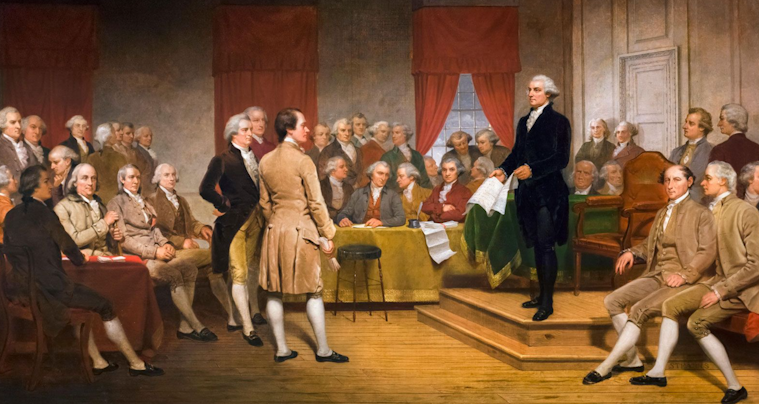
One solution would be to amend the constitution to impose a sunset provision on all legislation. This might be 20 or 30 years, so that this would not create a constant rehashing of legislation, but which would allow serious reconsideration of each measure. It would guarantee that the populace is always living under laws its representatives voted for.
Of course, some laws, perhaps those passed with a supermajority, might be excused from this. For instance, laws against murder, treason, robbery, etc., that have been long-standing and are widely accepted shouldn't need constant reauthorization. (Note that, to work, this principle of a sunset provision would have to apply to state laws as well.)
Now knowing legislatures, they'd probably try to create some omnibus monstrosity which would be a blanket reauthorization of all expiring legislation. This would of course defeat the intended purpose of this amendment. It would take care to word an amendment to limit this. Even if every dodge can't be anticipated, and a given legislature dodges the spirit of the effort, we'd not be worse off than today. at least there'd be the option to change things, and that might encourage the public to be more involved.
What Lurks In Handwriting
I worked in applied acoustics for a number of years, and this idea occurred to me one day while driving home. I don't believe that it is particularly practical, unless there were some special conditions, but it might be the basis for a good story if nothing else.
The thought is this: when you write with a pen or pencil on paper, that
writing device is acting like a microphone, picking up vibrations in the air,
and recording them in the trace left on the paper. This, after all, is the
principle by which the phonograph worked. The problem of course is that
the trace is very faint, and the signal (the words you actually are writing) is
all over the place when examined under a microscope.
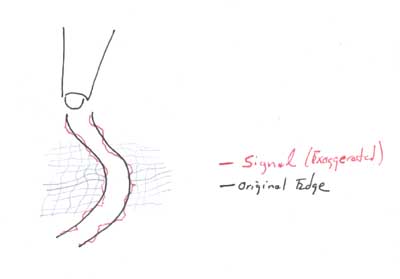
A pen held in a hand while writing (with no acoustic signal present) probably has a fairly simple dynamics. As it moves over the paper, the unevenness of the paper will cause some deviation from a completely straight edge. Adding an acoustic signal should cause further deviations from the intended path of the pen. (If I make a 1/4 inch pen stroke, it seems to take about 1/10 of a second; for a 1000 Hz sine wave signal, this would mean 100 peaks, with each peak having a separation of .0025 inches - this seems like a reasonable trace to detect.) Modeling what the pen would do due to the irregular surface of the paper, and measuring what it actually did in order to find the difference due to the acoustic influence might still be quite hard.
But if it worked! Imagine listening to fragments of sound from the room during the moment John Hancock signed the Declaration of Independence. Or any of a number of other historical events that took place when someone was writing.
Could it work? The acoustic energy is low, but it is there. The problem is in the analysis. One would have to build a mathematical model of the pen used, the ink, and even the paper (the threads of which would cause natural oscillations). Then, this model would be used to identify the parts of the writing (the edges) which were unexpected - these would be where acoustic information was.
While this seems almost impossible, and it might be, I would expect that the mathematical model for a hand holding a pen, moving over a known but rough surface, might be pretty simple - containing a few parameters no doubt, but the basic spring-like nature of the problem, the relatively simple abstraction of a pen (described by several moments of inertia), might be basic. It also might be such that all of these parameters could be learned by examining the entirety of the writing, either statistically or in detail.
Stepping back, while I'm not sure we could use this technique to hear the voice of George Washington or Napoleon, it might be used to verify that a particular document was written in a particular environment. Did Lincoln write the Gettysburg Address while on the train? I think that's a myth, but if it weren't, I expect it could be tested - the vibrations on trains, especially of his time, were sufficiently large to leave traces detectable to the human eye (as I've verified on Amtrak frequently).
A Unique Weather Display
For a number of years I had near-real-time satellite imagery of my part of the world as the background image on my computer. It was quite fun to watch storms move up the Atlantic coast, and gave me some intuition about why the weather was the way it was.
Thre are a number of sites where you may find such imagery.
I thought of a sort of sculpture, perhaps for use in the lobby of a large corporation. It would be a spherical CRT, that is spherical monitor, that would show real-time satellite imagery of the entire world. This might be engineered as a new sort of display device, or (if the radius were big enough) it might be composed of conventional displays in panes. It would appear to be a globe, but of course it would change with time.
I just googled "spherical computer display", and found that this is actually being done. I realize that links come and go, but here is one that shows a fairly large version of the concept:
They are not cheap. They are also huge. I'd like one that might sit on my desktop.
Zeppelin Yachts
I've always been intrigued with lighter-than-air craft. I believe that it would be possible to build small recreational airships, and that these would offer some extremely novel experiences. (While I've thought of this as "Zeppelin Yachts", this has nothing to do with the Zeppelin company, which is actually making airships again: http://www.zeppelin.com/)
Some time ago I illustrated a brochure for an imaginary company which would produce such yachts; I offer only a brief summary here.
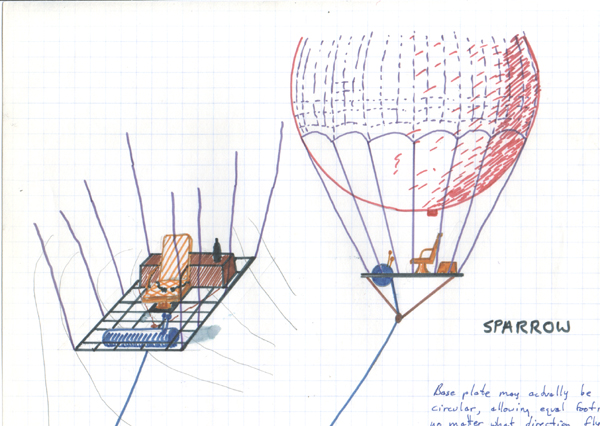 At the small end would be tethered helium balloons with one or two seats,
just to allow one to easily get up in the air. Helium can be expensive, so
it would be recompressed after each use.
At the small end would be tethered helium balloons with one or two seats,
just to allow one to easily get up in the air. Helium can be expensive, so
it would be recompressed after each use.
 A sports version would be unmanned, self powered, and would have a unique feature: a
precision winch with remote control, so that you could wear a harness, dangle
near the ground, and control your direction of motion. While this sounds
very strange, imagine it: you start at a beach, with the airship high above; you
command it to lift you 20 feet, and head out over the ocean. If you near a
boat, go up a hundred feet or so, and come back down. It would feel like
flying. The airship itself would be instrumented, so that if it had to
change altitude (say, due to temperature change, ballast drop, etc.) it could
autocorrect the cable length, keeping you at a stable height.
A sports version would be unmanned, self powered, and would have a unique feature: a
precision winch with remote control, so that you could wear a harness, dangle
near the ground, and control your direction of motion. While this sounds
very strange, imagine it: you start at a beach, with the airship high above; you
command it to lift you 20 feet, and head out over the ocean. If you near a
boat, go up a hundred feet or so, and come back down. It would feel like
flying. The airship itself would be instrumented, so that if it had to
change altitude (say, due to temperature change, ballast drop, etc.) it could
autocorrect the cable length, keeping you at a stable height.
(To do this right would take a bit of care - for instance, if the airship stopped suddenly, you might swing back and forth as you'd basically be part of a pendulum. This could be addressed with 2 or 3 lines, or some aerodynamic system above you to damp that out; or it may be predicted in advance and compensated for - or some combination of these techniques.
A sailing version would be tethered to a small boat with a centerboard and remote-controlled rudder. Below the helium balloons would be a sail, and below that you would hang in a harness, say 20 feet above the water. This would sail just as a sailboat does, but with significantly less friction. I expect it would be a very exciting ride, feeling like flying. (The balloon itself might be combined with the sail, in an inflatable airfoil shape).
These sketches were when I initially considered downwind sailing only, it was a quick but less-than-practical immediate idea. There is no reason not to use a Marconi-like rig; the sailships could then sail upwind. While this seems non-intuitive, sailboat masts don't transmit much torque, only a single force vector - separating the sail and mast structure from the hull therefore won't change the dynamics.)
After a little thought, I think that the right way to do the above sailship is to give the balloon an airfoil (sail) shape, so that there is only one thing to control - imagine a sort of kite with enough helium to safely keep its load up in the air.
Larger airship yachts might have cabins for extended cruising, sort of like campers in the sky. Modern materials, a high level of automation, and modern weather forecasting should make such cruising quite safe.
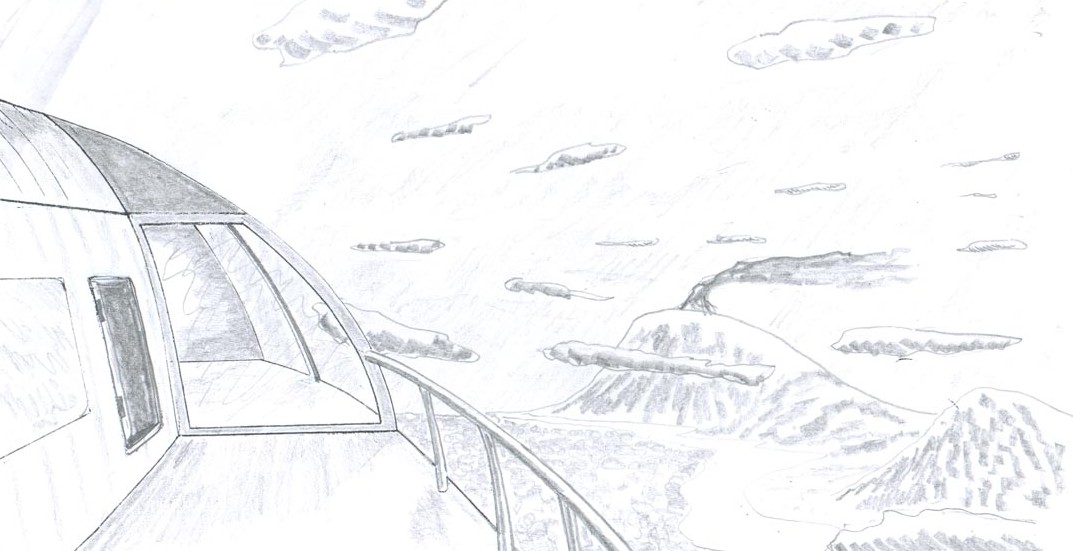
The problem with the larger 'yacht' concept is that the volume of helium required to lift a useful load is far larger than people generally imagine. I've ridden in the Goodyear Blimp, it was an amazing trip, slowly moving over the land. At the time their biggest cargo was the (then, non-LED) light arrays on the sides). As I recall that vessel had forward seats for a pilot and copilot, then rows of seats (perhaps 2 on each side) in the cabin, perhaps 5 or 6 rows. That was it. And the blimp is big. This becomes an issue when trying to maneuver in any kind of weather, and likely has safety implications in strong storms.
A Thinking Universe?
This was something that I first thought of back when I was in grade school - when I first heard about atoms and orbits, and had that common (then) image of an electron circling a planet-like nucleus. The idea was that in a similar way, our star and planets might be part of a larger system (but I'm not going with that cliche), one which perhaps exhibits intelligent behavior on vast scales of distance and time.
When mentioning this to an adult at the time, it was pointed out to me that planetary orbits and electron orbits have very little in common; the discussion stopped then. Still, there was an unresolved fragment in my mind. It came back when I started to read about Chaos Theory.
The essential part of that that I wish to discuss is the great sensitivity certain systems may have to initial conditions, or perturbations thereof. For example, if we delayed the Earth in it's orbit just a little bit, this would effect the other planets ever after - an effect that would multiply itself, as the changed position of those planets would in turn further affect other planets and the Earth, possibly magnifying the initial change. Very slight changes in state may thus lead to very different results.
This you may have heard of as the 'butterfly effect', and how it affects the predictability of certain systems. (I'm not going in that direction either).
Such a system might be said to be computing something, although it is very hard to say what. We could take the solar system as a very sensitive analog computer, but we have no idea what (if anything of importance) is being computed.
Now add the rest of the galaxy; the inherent complexity is such that we can't even conceive of a computer which could accurately model the motions of all the stars, planets, asteroids, etc., other than the galaxy itself.
Given the large distances involved, and the unfortunate limitation of the speed of light, what happens will happen over scales which our race is unlikely to experience. For the moment, ignore the scales of time and distance involved. In principle, is it possible that certain bounded parts of the universe show intelligent behavior? (I say "bounded", because if it's the whole thing, there's nothing to interact with such an intelligence, and it would be restricted to contemplating its own existence.) The number of components and the number of interconnections is greater than that of the human brain, so why not? While it's possible, I'm not sure we could figure out a way to ever know - but it's an interesting idea I think. What would the universe's memory have in it?
One friend of mine remarked that if we could read such memories, we could probably alter them, and therefore would seem like a sort of virus or disease of the universe. This isn't too pleasant a thought, but this entire idea is such a stretch that it's only use is probably in a science fiction story.
The Electronic Blackboard
This is an idea that occurred to me in the early 1980's, and I still haven't seen anyone do it as I'd want it, though there are now versions out there.
I wanted to build a device that would appear to be a blackboard, but which would be electronic instead. My first approach was to use a rear-projection TV, and instrument the screen to be touch sensitive. The user would write on the board with a non-marking stick, the position would be read and the projection pixels would change to "on".
Nowadays this might be doable with an LCD or plasma display. The particular technology interests me less than the possibilities.
An person might use the board in conjunction with handwriting recognition software, so for example as you wrote out algebraic problems, a Macsyma-like symbolic mathematics program in the background could generate solutions. Or an instructor might write out a problem statement and solution, and have the computer driving the system produce notes with all of the solution steps included.
A person could move text around on the board, save it, print it, transmit it to other locations. Images from other sources could be shown - animations illustrating concepts, or web cameras. Other interactive programs could be brought in as needed, for example spreadsheets.
For interactive exploration of data (say before a board of directors, or students, or clients) it would be great. It would allow powerful collaboration between people who are remote or face-to-face. One could assign board areas to particular people, and allow them to control those areas from their own laptops, so that everyone could see everyone else's work in one place.
As I noted, things like this have been done. I haven't seen anything integrated with problem-solving tools such as math systems, or database lookups. Getting this to work on a tablet might be best, as one could work individually, or 'project' or 'share' the screen if teaching. But I think I'd prefer an interactive research tool, perhaps as part of an electronic lab notebook.