"Continental Shelf" Thoughts
It may seem an odd part of the title, "Continental Shelf", but some essays out in the world should be considered deep thoughts, some are just shallow thoughts, and as most of these are in-between, it seemed like a good working title.
On Accidental Reincarnation
"And now for something completely different." That is, from what you might expect given the other topics scattered around these web pages.
This may seem a bit mystical, and I'm not - so it isn't, really.On a birthday a few years ago I recalled a thought I'd had when much younger, when I wondered if I would be much different as a person if I'd been born another day. The main difference might be one that perhaps provides a shadow of a rationale for the personality predictions of astrology: I'd have spent my first months of life in a different season, and one might imagine that this could color one's view of the world. My first six months or so were spent during the cold and dreary months of the year - perhaps I'd be slightly different if it were Spring and Summer instead.
That isn't really what I was after, though; I thought it might be an interesting exercise in imagination to toss away personal details, and see how much of "me" was left as I went along. Would I be the same person if I'd been given a different name? I think so, without a lot of doubt, though having a "B" at the beginning of my last name got me through lots of institutional processes faster than I would have been had my last name been "Zuppa" or "Zabaglione". So there might have been some small difference, but I don't think it'd have been significant.
It's an interesting exercise to try - what if you'd been born in a different country? What if you'd been born in a different century? How much of your personality, your "soul" if you wish to consider it in those terms, would be the same, and how much would be different?
My view is that I'd be the same person, though my different experiences might have led to different choices in life. I can't get away from the sense of having a central identity that wouldn't be subject to the vicissitudes of time and place.
An older TED talk (Technology, Entertainment, Design; www.ted.com) by Steven Pinker, "Chalking it up to the blank slate" (just under 23 minutes long; well worth the time) addresses this from a neuroscience point of view. The evidence he cites for surprisingly similar behavior from identical twins, even raised in different environments, he uses to point to the importance of underlying brain structure as a determiner for human nature. Even twins aren't *exactly* the same - and if one of us were born in another place and time, physically identical to who we were at birth, we'd be even more similar to our current selves than twins are, despite environmental differences.
Then I began to wonder: who in the past might have shared some or all of the elements that make up that identity? It really doesn't matter if you get to be the way you are via nature or nurture - what you are in terms of outlook, personality, affinities, and so forth may have existed before, and may exist again at some time in the future, in whole or in part. I don't know quite what to call this: perhaps 'accidental reincarnation". It doesn't require any mysticism to consider it a possibility.
Perhaps this has happened to you: you'll be reading some bit of history, before you turn the page you think that if you were there/then, you'd say something specific, or react in some way - and you turn the page, and find that the person said or did just that. Now in the obvious cases this isn't so striking - if nearly anyone would have said or done it. But what about when almost no one would have? It can be a very eerie experience, the sense that some part of your mental life existed before you were born.
A few years after this idea had occurred to me (this was in the 1970's), I stumbled on a poem of Jorge Luis Borges. It's not particularly his best, but the fact that it touches on the same point was a bit of a surprise:
Inscription On Any TombLet not the rash marble risk
garrulous breaches of oblivion's omnipotence,
in many worlds recalling
name, renown, events, birthplace.
All those glass jewels are best left in the dark.
Let not the marble say what men do not.
The essentials of the dead man's life -
the trembling hope,
the implacable miracle of pain, the wonder of sensual delight -
will abide forever.
Blindly the willful soul asks for length of days
when its survival is assured by the lives of others,
when you yourself are the embodied continuance
of those who did not live into your time
and others will be (and are) your immortality on earth.
Perhaps my surprise when reading this was that it almost proves the point: while wondering if there were others in the past who'd thought similar thoughts to my own, I'd found someone else thinking the same thing. (Though that person was still alive.)
The "(and are)" part in the last line hadn't occurred to me (and I must admit this whole topic was something of a passing thought). It's not just that there may have been people in the past (and may be in the future) who to a lesser or greater extent were "me", but that this may be true of others alive now. And of course it's not that they're identically me; they may just have some overlap in attitude, imagination, instinct, emotional response, world view, sense of humor, or any of the other aspects that make up the mental life of an individual.
Maybe we do intuitively understand these kinds of mental life overlaps; when reading history, or even watching a movie, we identify with some characters, and can at least appreciate the actions of others, even if we wouldn't act like they did. If we couldn't do this, there'd be little value in history or literature. To the extent that I understand Christian thinking about the brotherhood of man, I make sense of it this way: we each share a little bit of each other.
One can take this further - Terence (Publius Terentius Afer, 185 BC - 159 BC) said "Homo sum: humani nil a me alienum puto " (I am a man: nothing human is alien to me). When I first read this I thought it to be quite powerful, but over time I've come to doubt it: when I read of certain types of crimes, too bizarre or disgusting to mention here, I feel I'm touching something alien. On the other hand, these human actions may just reflect mental illness. Or perhaps we define something as mental illness precisely when we can't empathize with it at all.
The type of overlap of mental outlook I'm speaking of might even cross species boundaries, though probably with some inherent limits. Anyone who has spent time around dogs knows they have distinct individual personalities, and, even ignoring the anthropomorphism we sometimes bring to such observations, one may find traits that humans share. I wonder how far one might take this - say, if the mind of a dinosaur that walked her 70 million years ago, perceiving similar landscapes, may have had some overlap with how I see the world. It may be that such similarities are an inevitable hallmark of consciousness.
I found another poem recently, unpublished for some time, this one by Cavafy. He's perhaps most famous for "Waiting for the Barbarians", but others of my favorites are "Ithaca" and "Thermopylae" (if you've never read them they are worth the brief detour). While this next one may have more to do with the specifics of Cavafy's life, it still touches on the same theme:

HiddenFrom all I've done and all I've said
let them not seek to find who I've been.
An obstacle stood and transformed
my acts and way of my life.
An obstacle stood and stopped me
many a time as I was going to speak.
My most unobserved acts,
and my writings the most covered -
thence only they will feel me.
But mayhaps it is not worth to spend
this much care and this much effort to know me.
For - in the more perfect society -
someone else like me created
will certainly appear and freely act.
So I'll die, my specific memories vanish, but some day, maybe many days, a new person will be born who will more or less, in many combinations, be me.
The "Older" MetaPhysics
"Meta Physics" originally meant the philosophical underpinnings and basis of physics. The prefix "meta-" seems to have taken on its own variant meaning, and while "metaphysics" still has a lot of its old flavor, it seems to have spread out a bit in meaning. I'm writing here about the original restricted definition.
Long long ago I read a quote from a theologian of the late middle ages - I believe Spanish, but that's just a vague memory - and the gist was:
If God fails to give full attention to my hand writing on this parchment, my hand and pen and everything else here, it will all evaporate into nothingness.(This is just my memory - I'd very much like to find the original. It's hard, because the key search terms turn up so much. Perhaps it was from a work of my (extremely brief) acquaintance with Jorge Luis Borges - it kind of feels like something he may have written).
This struck me then as a very weird idea, a kind of "hyper-theology" in which God has to mind every molecule all of the time. And at the time it was written it may well have been intended that way.
Note that (and for shorthand, keeping the above caveat in mind) the laws of Physics do affect every part of that medieval author's hand, pen, paper, biology, the gravity that holds him down. And it does so at a very detailed (I'd say "ultimately detailed") level, beyond even what we can measure. When this thought hit me I wondered if that author centuries ago had said far more than he knew.
Perhaps a decade ago, we were hosting a holiday dinner - I do not recall which one it was. Among others, my father and brother were in line for a buffet thing for hors d'ouevres, and some mention of God was made. Perhaps inspired by a pre-prandial cocktail I said "I can prove God exists in about 10 seconds". They, of course, looked at me as if my cocktail consumption had been far too high. But I next said "Something keeps the laws of Physics the same. I have no idea if what that is is conscious, or cares about us". I sensed they tacitly agreed.
I'm by no means the first to think about this - "MetaPhysics", the word, is in essence the "Why" of Physics, which in itself pretty much describes only the "How". The "laws" of Physics are just imperfect rules we've figured out by observing how things work - we still have no idea of what they would be if we knew them all, or what form they'd take. They may not look like "laws" at all, just basic principles, or invariant quantities, or, well, things we've yet to imagine.
So where are (or in any way could be) the laws of Physics written? It’s an ancient term, something “being written”. It was meant it first as ‘recorded’, ‘set down’. Though thinking about writing and reading, it’s fairly new to humankind, and brings its own baggage. For instance, it requires a “book” (think of any of the few holy books out there), but also requires a reader – perhaps someone wise enough to read the general moral or behavioral laws recorded and apply them to a specific situation, articulating to others how and why that application makes sense. And in the sense of "laws", it's not just a reader, but some kind of 'enforcer'.
The laws of Physics can’t be like this – unless every element of reality is some kind of ‘reader’. The phrase itself seems an artifact of human history. So, “Where are the laws of Physics written?” There are several possible meanings to this, and it seems we can’t really even clearly conceive of such an encoding.
Let me be a bit more specific and local - I recall many years ago watching a baseball game, and watching the ball. The question that came to mind was “How does it know how it’s supposed to keep moving?” (I was well aware of Newton's laws - I was wondering where the information was.) Please ignore the anthropomorphizing going on here – I’m not suggesting the ball has a mind. But there must be some information about what it’s doing that keeps it going – otherwise it’d just stop, or do something else. Where does that information exist?
Now a quick thought might be that it’s apparent mass is slightly larger due to relativistic effects (in my reference frame it's moving, so it's mass is larger), and that’s an encoding of that information – yet that information doesn’t carry any directional info. (The object, to me, shrinks in the direction of motion, so that information is there, but it’s an aspect of my frame of reference, nothing like objective information.) Maybe if one took the infinitly-large ensemble of possible observers this might be enough, but that's just, if not more, as weird of a problem.
In recent decades we have a new idea that didn't exist before: people have considered the option that our universe may be a sort of simulation, and all of the underlying data and rules about how things work are in the ‘software’ running this simulation – something we may never have direct access to. Given the amount of information within the universe (quanta of space, number of particles, entangled particles, field strengths at every location, and on and on) it seems kinda nuts (to use a technical term). It certainly seems a bit too "cute", but before the modern era the idea wasn't available - an "outside" entity imposing the rules; but we now have virtual worlds in which that's true.
I'm sure many might say about where the rules are: "Well that's just God". Now they might be right, at least on their terms, but it just seems like a name for "What we don't know" (though an unknowable God might be the answer, that kind of 'stops' Physics research at a somewhat unpleasant wall). In reviewing the metaphysical literature, there's not much there that I find compelling - nice quotes, yet despite their apparent profundity, I find little to hang anyone's hat on there.
Let me offer one analogy, that gets into Socratic ideals. Take the statement "2 + 2 = 4" (or any other mathematical truths, whether geometric, set theory, whatever - if you like just take the basic axioms, not anything derived). Even if the universe didn't exist, if there were any sort of intelligence "outside" of it (God, or a parallel universe, or who know what) that mathematical statement holds true. And even if there aren't. Where are those truths"written"? And is this the same underlying problem?
(I can almost feel a horde of modern philosophers descending upon me, about what I mean by the word of symbol "2", or "+", how do I define these in the absence of anything else, and so forth. For now, let them sit in the anteroom.)
Platonic 'Forms' are of this, well, form (Plato was a student of Socrates). They exist outside of what any individual thinks or perceives, and seem, in essence, not unlike the 'laws' of Physics. They just are. If I could tell you why I'd likely not be sitting here typing a website entry.
The 'simulation' theory holds maybe the glimmer of an answer (though not an attractive one). These forms and underlying rules that effect every tiny bit of space and time were set up and are managed by some computational engine (I won't yet again refer to it as God, as for all I know the real God created an uncountable set of different variants.)
The motivation for writing this was just that, now, in recent decades when we've been able to create quite realistic world simulations, we have another way to possibly think about the problem. It doesn't feel very sound to me, perhaps as a Physics guy I can see no way to test it, and it seems highly implausible, but so does whatever it is that runs our universe, from the subatomic to the cosmological scale. I'll let the theologians and metaphysicians try to sort it out.
What form would a satisfactory answer have? The only intuition I have about it is that the laws/forms/etc. are as they are because they are the only consistent possible way they could be. Now that's somewhat easily criticized: what if there were nothing in existence? (Trying to think about that can twist your mind a bit - I don't mean empty space, but no space and no time whatsoever.) Any set of rules would be logically consistent then, as there would be no possible realization of a contradiction. So maybe I should qualify my intuition by saying the laws are the only non-contradictory way they can be in a universe in which I can exist and write about it, and you can exist to read about it.
Metaphysics is like being in a dark room and looking for a black cat that isn't there.
Reflections on Time
Like many people, I've often wondered about time. This section is on two particular thoughts:
1. How thick is time?
2. Is there a past out there?
1. How Thick Is Time?
What do I mean by this? Well, time is considered a dimension, so we have X, Y, Z (for 3D space) and T. You can describe a point (event) by giving these coordinates. Think of yourself reading this - you're in some particular spot, and time is flowing along. Consider the instant which you perceive as "Now". Is it just a point along the T axis, or does it have some thickness?
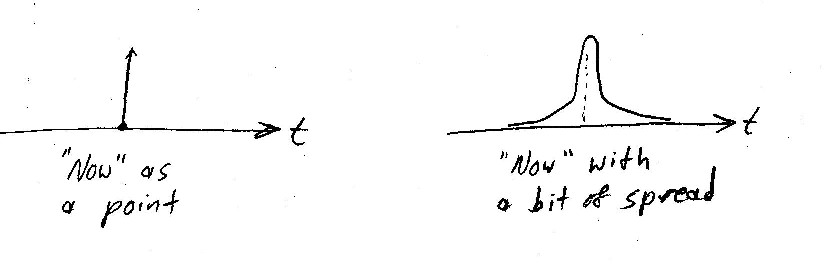
Either choice seems bizarre. If we exist "now" at only a Euclidian point, we are infinitely thin in the time dimension; this offends my sense of what existence needs to be. While mathematically a well-defined concept, it just doesn't seem natural to me for it to be reduced to a single point in one dimension.
If "now" has some thickness, what would this mean? It could mean that "now" is a little bit of the past, an instantaneous (traditional) "now", and a little bit of the future. I'd expect that this thickness would be very small, or we'd perceive some odd things going on in the universe.
Or maybe we do perceive such things (though this doesn't necessarily involve the concept of 'thickness'): perhaps we do experience what might be described as a tiny fraction of the future as part of "now". If we do, memories of that might naturally be noisy. There are a number of ways to think of this - one way is that we move forward a bit in time, then back, then forward again, with the flow of time carrying us ever into the future - sort of like a swimmer moving back in forth in a flowing river. Now if this were really to happen, I might have a memory of the future - but while moving back to my current (traditional) "now", this memory would have a hard time persisting (the physics of this would work against preservation of memories - they might be recalled as only scattered, barely intelligible fragments).
Every few years I like to pick this idea up and play with it. In particular, I'd like to see if there is any way to get quantum mechanical measurement uncertainty to tie in with it. I think one fatal flaw might be Special Relativity - if someone flies by me close to the speed of light, and if the laws of Physics are the same for him as for me, time dilation should mean that I see his "time thickness" as quite large. But we don't see this. Maybe there's some way to come up with a 4D time-space interval, invariant to all observers, that's almost entirely time, but I don't think relativity allows this. For at least some observers a spatial component would necessarily appear.
2. Is There A Past Out There?
This is directly related to the above point.
Long ago I was discussing time travel with someone, and said that I thought that while it might be possible to travel into the past, there'd be nothing there. He said "What do you mean?" and I pointed out that all the matter and energy that was in the past is now in the present - unless it makes a copy of itself every instant, which seems like too strange a notion.
So if you could go back to 1863, you couldn't, say, find the battle of Gettysburg - you'd likely find just empty space, if that. Or, who knows, perhaps there is an entire other universe there, completely different except in physical laws. Existing where we experienced our past, we'd have no way to observe, test, or in any way be aware of it.
This is related to the "Thickness of Time" section in that it might be that what we experience as "now" is all that there is. Whatever slice of time we exist in might be all of existence. I'm not particularly upset by this, except that it throws into question whether it makes sense to talk about the past as hard fact: there would be in principle no way to test the past to determine if it were one way or another.
Every once in a while I run across something like this in physics literature. For example, from a Stephen Hawking website:
David Deutsch claims support for the alternative histories approach, from the sum over histories concept, introduced by the physicist, Richard Feynman, who died a few years ago. The idea is that according to Quantum Theory, the universe doesn't have just a unique single history.
Instead, the universe has every single possible history,each with its own probability. There must be a possible history in which there is a lasting peace in the Middle East (though maybe the probability is low.)
The 'sum over histories' approach is real:
The sum over histories is a foundational idea in quantum mechanics, introduced by Richard Feynman, that describes how quantum systems evolve by considering all possible ways a particle or system could reach a given state, rather than following a single, definite path.
So maybe it's not just "no past", but "every possible past". (I recommend some internet reading on this, I don't want to get too far into it here.) Let me naively note that the laws of Physics are usually time-symmetric (well, charge, parity, time symmetric, sorta - for instance, we see an electron moving backwards in time as a positron). The point being that if sum-over-histories holds for the past it's mirror image should hold for the future: it seems to mean that the universe moves forwards in all possible ways too.
So who knows. The first step in giving any serious thought to a "thickness in time" is to figure out to experimentally verify it, and I've not thought of such a thing.