MIT-related activities
Educational Council
For roughly two decades I was an "Educational Councillor", the main duty being to interview MIT applicants. (I was also the Regional Coordinator for this corner of Connecticut, but that's a different and mainly uninteresting topic).
I found this (volunteer position, if that's not obvious) to be both challenging and satisfying. In another line of activity that won't appear here, I'd been somewhat professionally trained in interviewing and analysis, which did help, but when you're talking to 17 and 18 year olds, it didn't make much difference.
If you remember how you thought at that age, you'll realize you may not know "your passion", really what you want to do - you might know a lot about what intrigues you. I never interviewed people with an attitude of "are you good enough" - councillor's don't see transcripts or such. I'd try to find out what they were curious about, how they thought (no trick questions, just talking about topics they were likely to know about), and maybe a little about their personalities. My writeups to the MIT Admissions Office really focused on the personal strengths I saw.
Two categories of applicants that were mildly problematic: one consists of applicants who were "pumped" - their parents sent them hither and yon, to rack up items 'for the resume'. You could tell after talking just a little bit how genuine interests were likely to be. I didn't judge based on this, after all it seemed mainly parental forces at work, but I don't think (absent sincere interest) that it does much for anyone.
The other category were people who just didn't seem like they'd fit. It wasn't my job to judge that, but sometimes you could just tell: mild work ethic, no direction that would induce them to change, in short not like any MIT students I knew that lasted. Again, I'd try to find strengths and report those - and of course often I'd be asked what it was like there, and I'd be honest (not any harsher with this group than any other). Some got in and did fine - that age is an age of maturing, so I can see that working out. I don't think I ever reported my assessment of the above in any of my reports to the admin office. But one could tell some people just might not be happy there.
While I (of course) didn't interview her, our oldest daughter was thinking of MIT. She had the academic and other chops to get in on her own (as far as I know there are basically no strings to pull - it at least was all merit based). I didn't say "you should go", or "you shouldn't go" to MIT - she liked her interviewer there, but couldn't stand the smarmy new crew coach. She picked Princeton, which fit her far better. Even as an interviewer you kind of want the person you're talking to to be happy where they end up, not in an intense place that they won't like. I was always aware those weren't my decisions (both from an admissions office point of view, and in terms of applicants' preferences).
If it seems I've gone on too much about that, in a way it's why I stopped doing interviews - I'd been away from campus so long, my friends who were grad students or faculty had moved on, and, though my sense of what MIT is might still be accurate, I no longer had that 'feel' of life there.
The Technology Hackers Association (T.H.A.)
When I was a senior (for the Physics degree - I stayed for another in EECS), I'd been looking at grad programs, didn't like the overspecialized slots, in general wasn't sure what to do next. This added a lot of stress. Just to relax I got into the hacking world (nothing to do with computers.)
It started with something called F.D.C., the "Freshmen Defense Corps" - basically an organized anti-hazing group that specialized in water fights. (You do have to realize that most if not all of what I'm writing about here has a bit of silliness to it).
After one successful Fall, opposing "Freshman Shower Night", we came up with the idea for a hacking group. I'm the founder, though it wouldn't have gotten very far without strong help from other early members, so it's best to think of it as a team effort.
What is MIT "hacking"? Part is exploration of rooftops, tunnels, odd spaces - almost 'urban spelunking'. But one reason for doing that is to be able to hang banners, or create other entertaining 'art' or amusing events. (At the time MIT would try to shut these things down almost immediately - later it became a 'cultural thing' and the basis of fundraising, so it was celebrated.)
From one article by Eri Izawa:
But as common as hacks have become, they still require a great deal of insight, hard work, and old-fashioned engineering. Although some hackers may not fully realize it at the time, the production of a successful hack follows the same creative and technical process as any large-scale engineering project - with the added complication that, along with traditional issues such as cost, safety, manageability, hackers must avoid getting caught by the Campus Police! (Though many hacks happen in public places, some are set up on places such as rooftops, which are not meant for public access.)
To be clear I did not start MIT hacking - it had been going on for quite some decades. But during the late 1960's and early 1970's, the campus riots and such basically killed it - MIT began to secure spaces much more seriously, and students then had more serious concerns. I arrived there in 1977, and there really was no hacking. Other groups began to revive the tradition, notably the DKE fraternity with their balloon at the Harvard/Yale football game.
I'd met people who knew a lot more than I did, so when I set up T.H.A. I gave it an organization. There was a President, kind of a figurehead; a Chancellor, who was in effect the CEO; then different departments: Finance, Public-and-Other-Hacking-Group Relations, and Intelligence. The Intelligence dept. had subsections: Building Intelligence (mainly acquiring and managing blueprints and the like), Technical Services (ways to bypass alarms, comm devices, etc.), and two other sections I don't clearly recall - though one was "Covert Operations". While that sounds ominous, one member had a set of master keys, and if he were ever going to use them we wanted no one to know. There were likely other cases of 'inside knowledge' that we just didn't want to spread around. Anyway, the whole point of this was to make sure that information needed for hacks was both collected and preserved for the future.
We did often work with people in other groups, so we wouldn't publicly claim credit for any of that. Indeed we wanted to be unknown - people had numbers, longish, but typically the last 3 were the sequential membership number, starting with my '100.
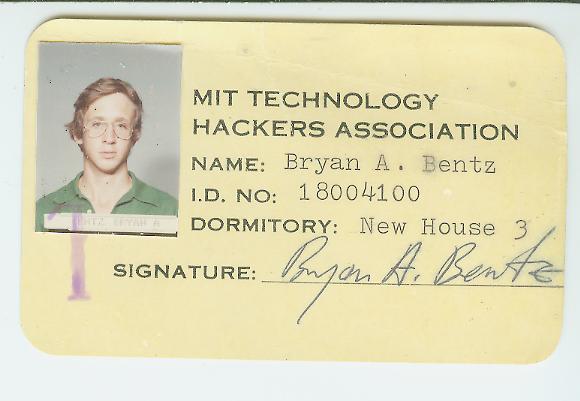
I didn't want people doing this for personal credit, fame, or resume use - it was to be for the fun of it, or not at all.
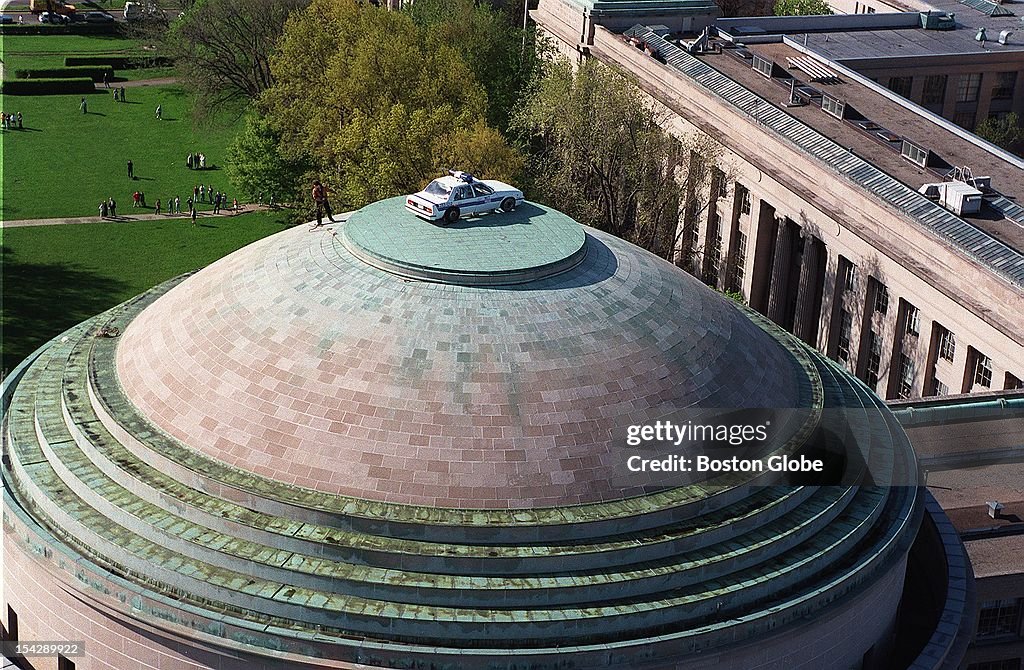
One of T.H.A.'s successes was putting "the police car on the great dome":
I was interviewed by Playboy Magazine at one point; I stayed anonymous. 25 years or so later my daughter found this copy of Playboy on my bookshelf and asked accusingly, "Why do you have this?" My answer was "Because I'm in it." Which probably surprised her more than finding it on my shelf. In other interviews I've never really said what I've done - not that illegality was involved, but in the spirit of doing all of this without intent to take personal credit.
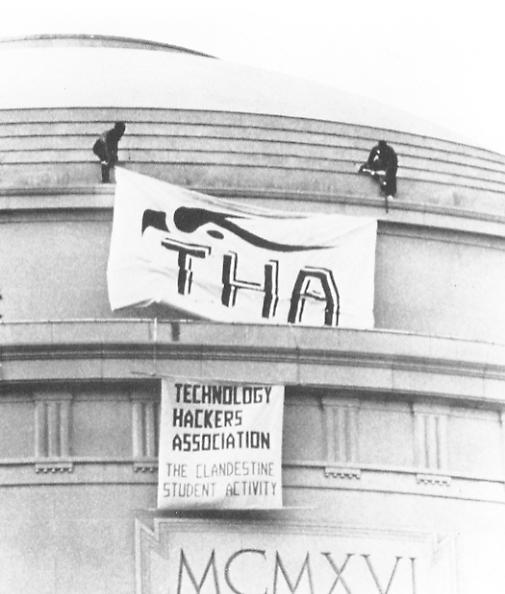
(The lower banner, with "The Clandestine Student Activity", got a bit of notice.) Two interview articles where I appear rather blandly:
One of the interviewers told me (quite a bit later) that he'd talked to an undergrad who told him he'd chosen MIT to come to because of some of the hacks he'd heard of (some of which I was involved with). That struck me as a positive outcome I'd never have expected.
The MIT Museum used to have a hack exhibit; I've heard the physical one may not be present, but a quick search showed that the spirit is still alive: hacks.mit.edu. There's also this: Hacking section in Mind and Hand book
There are a few books out there, some mention T.H.A. (or have T.H.A. as authors or contributors - but you won't read that):
- The Journal of the Institute for Hacks, TomFoolery, and Pranks at MIT by Brian Leibowitz.
- "Nightwork: A History of Hacks and Pranks at MIT" by "Institute Historian Peterson". Easy to find more about that on Amazon.
- The Idea Factory: Learning to Think at MIT by Pepper White.
I learned a lot doing this - as the quote mentions, and one of the articles says, it was great prep for project management. I saw a very few people misuse what we might teach them, but we did focus on safety. Exploring the odd spaces taught me a lot about architecture (and what is forgotten), which I found was actually quite useful when I became a volunteer firefighter.